



In discussions with Collective members since releasing The 4 Rules of This Infinite Game, one question has repeated most frequently: “If there are no rules to the game, how do I know which approach to trading I should pursue?”
My best advice is Naval Ravikant’s advice: audit your current trading process for what “feels like play to you, but looks like work to others.”
Which part of your trading process gives you energy? Which part depletes it?
Which part do you find yourself becoming lost in—where you begin, and shortly thereafter your sense of time completely falls away?
For some, this may be paging through history books, building a mental vault of era analogs. For others, studying geopolitical dynamics and power shifts. Others still may wait in eager anticipation to crack open a dozen fresh 10-Qs come earnings season.
For me, it’s pulling up my trade logs and tinkering with alternative screening criteria, trade management techniques, and position sizing. Entire days have passed while I’ve played in the sandbox that is my trading database—40-plus columns, 1,000 rows, dozens of tabs—now supercharged by AI’s ability to craft formulas light-years beyond my technical capability.
When others catch me in a post-analysis sprint, they cringe. “That looks like a lot of work.”
I beam. “To me, it’s play.”
We all have parts of our trading process that are administrative necessities. But if you feel you “should” study more geopolitics, I suggest trading macro is not your unique path. If you feel you “need to” grind through recent 10-Qs, I suggest fundamental analysis is not your unique path. And if you feel you “must” build out an advanced, dynamic, AI-powered trade log to achieve your desired results, purely technical trading is likely not how you’re meant to engage with markets.
Let the “shoulds” and “need tos” wither. Align yourself with what feels like play.
That feeling—an uptick in energy, a loss of time, flow state—is the marker of your intuition pointing toward the unique trading path you are meant to walk.
View from the bottom
My breakout trading starts with a bottom-up screening process across thousands of individual stocks.
Doing so gives a much different perspective on the market’s health and resiliency than other approaches, such as top-down screening or using indices alone.
After the sharp market sell-off last April following President Trump’s “Liberation Day” tariff announcement, my bottom-up screening process had me feeling stuck in the mud for much of the remainder of 2025.
Market trends were contained within narrow thematics—AI infrastructure, metals, large-cap tech. The slow drift higher in the indices created the illusion of wide market participation, but the reality under the hood was not so. Candidly, it was a very challenging period for my strategy as there were so few setups—and those stocks that did set up outside of the aforementioned themes failed to follow-through.
What I have experienced in my bottom-up process since last December has been the complete inverse. The crowded themes that defined 2025 have taken shots across the bow. The indices have stuttered and stalled. SPY’s return YTD stands just over 1%.
And yet quality setups have proliferated in my screens, and breakouts are following through with strength.
Capital appears to be rotating out of the overcrowded 2025 thematics and into new sectors of the market.
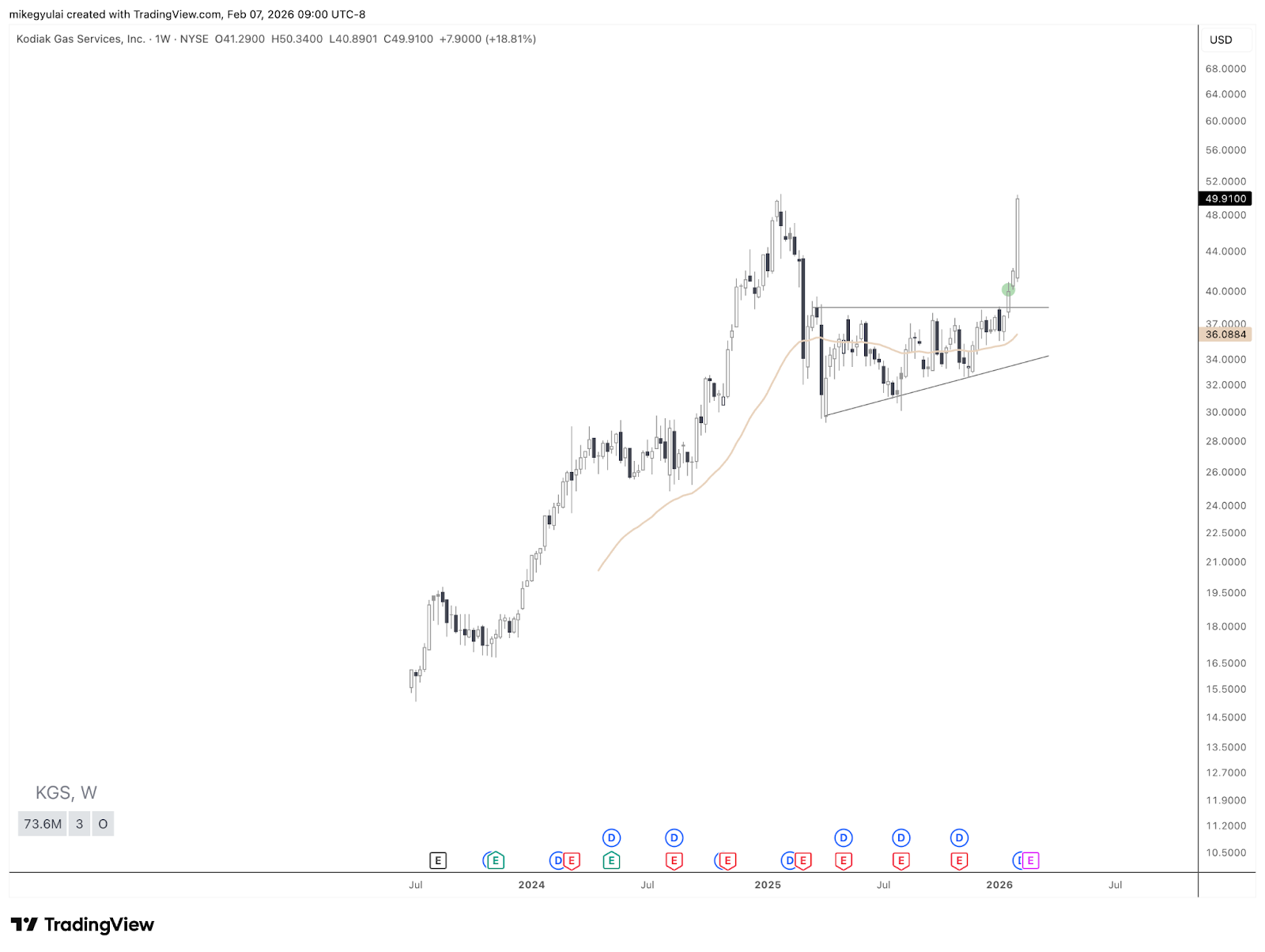
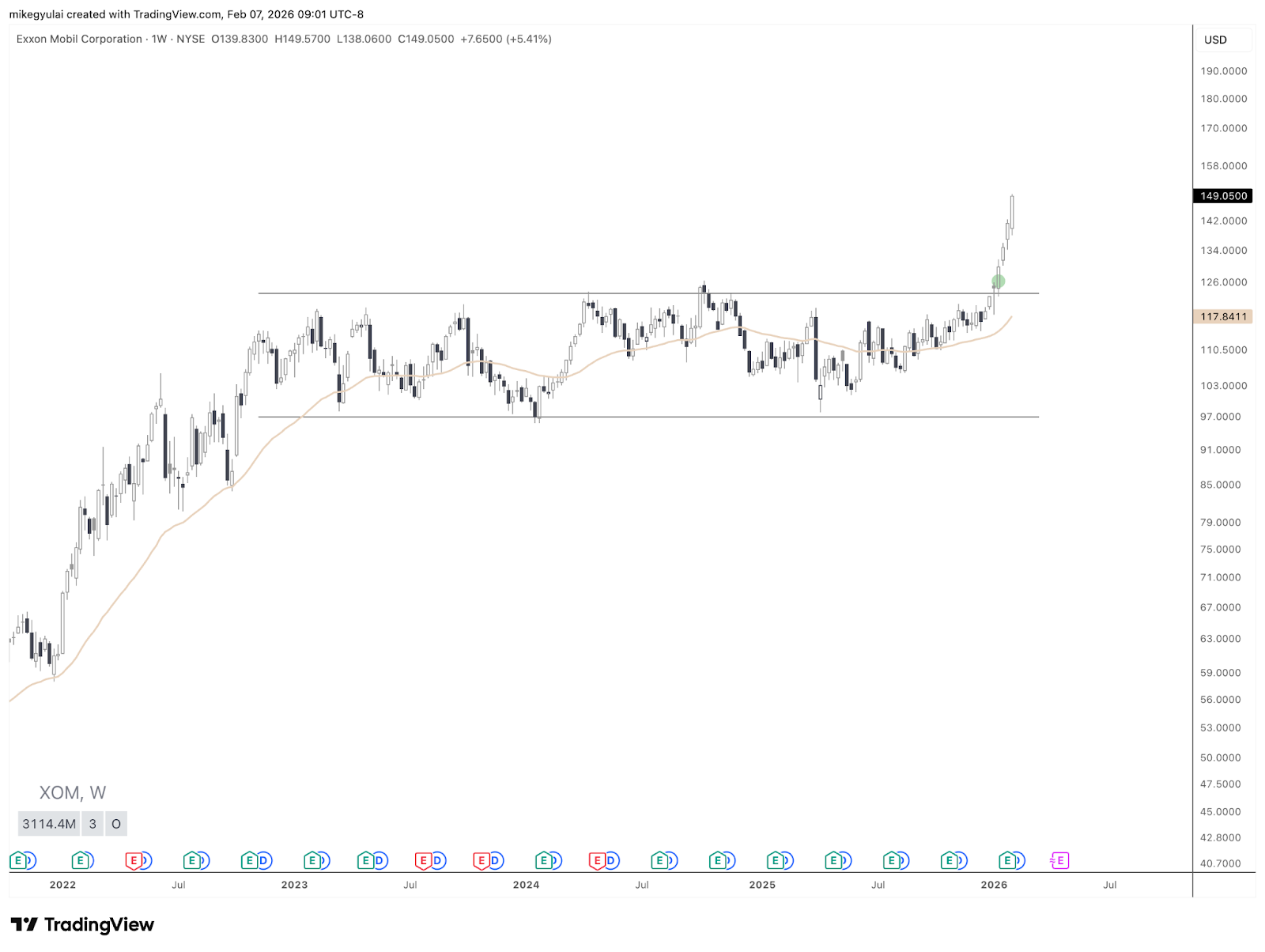
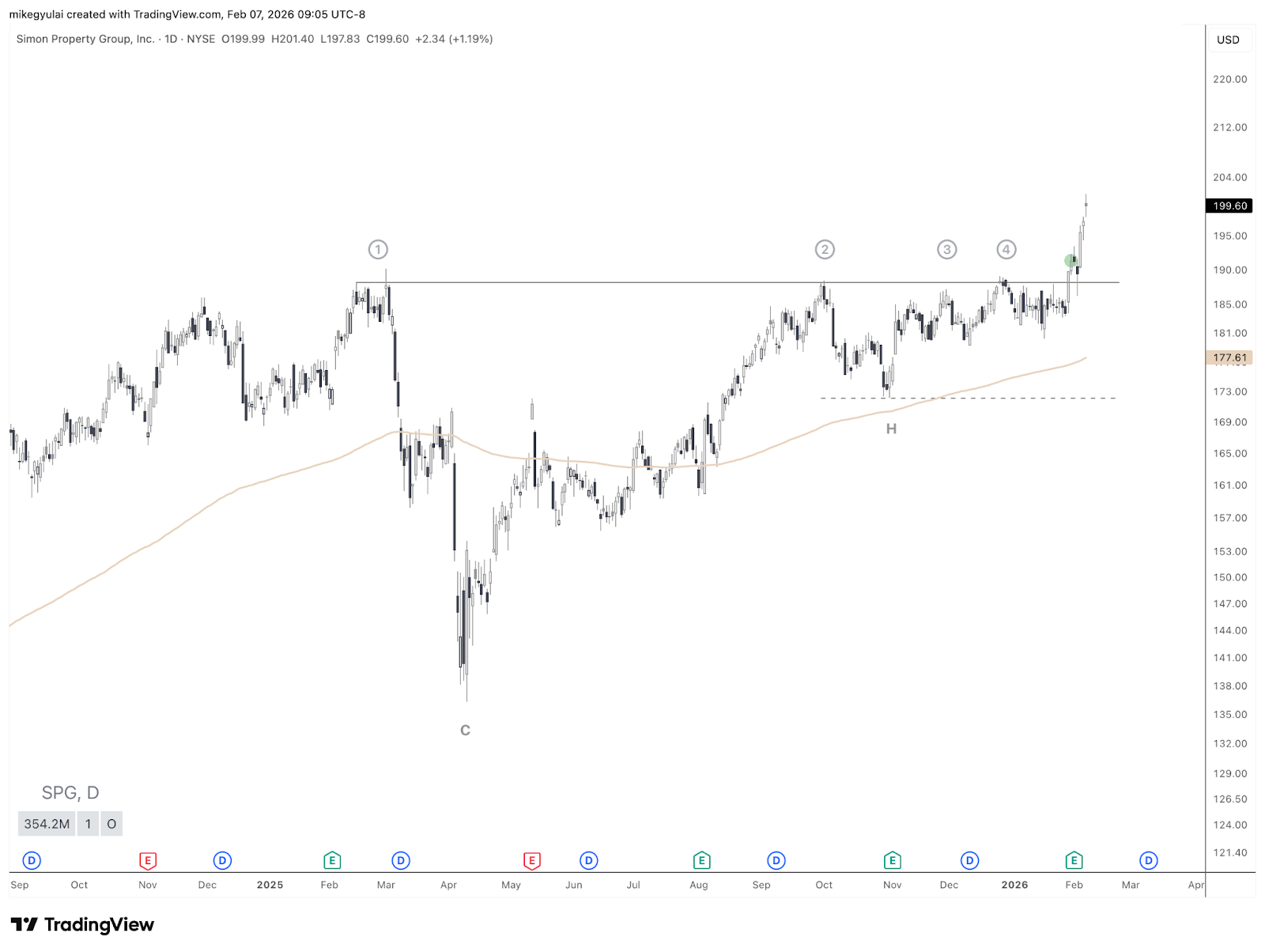
Evidence of this can be seen clearly in the positions of our Macro Ops portfolio:
Kodiak Gas Services (Industrial Services) put in a monster week.
Exxon Mobil (Energy) broke out a month ago and has not looked back.
Simon Property Group (Financial Services) kissed its breakout level on earnings and pushed higher the remainder of the week.
It’s clear that the market environment has shifted. This week’s volatility was quarantined to specific overcrowded sectors and did not cascade into a broader risk-off stance.
We are in a different market environment than 2025.
And I, for one, welcome the change.
Pyramiding in micro regimes
Well-studied traders implement regime filters as a way of increasing the probability that their trades will follow through.
Regime filters increase the win rate and overall expectancy of a setup without changing anything about the setup itself. Rather, they allow the trader to sidestep periods when market conditions are adversarial to their style.
Trend traders, for example, may use a series of moving averages which, when stacked and sloped in one direction, give them the green light to push their edge.
My own breakout system has both a trend filter as well as a whipsaw filter which systematically switches on or off my willingness to put capital at risk, dependent on market conditions.
In the December 06, 2025 issue, I featured an exploration of how I thought about compounding gains in trends that have already proven themselves. By screening for High Bases and Flags within my own active breakout positions, I was essentially defining a “micro regime” within my larger trending regime.
The higher-timeframe trending regime enabled breakout positions to initiate in the first place.
The breakout trades that followed through defined a lower-timeframe micro regime within which short-term patterns such as Flags and High Bases become favorable setups.
This week offered two wonderful examples of such opportunities …
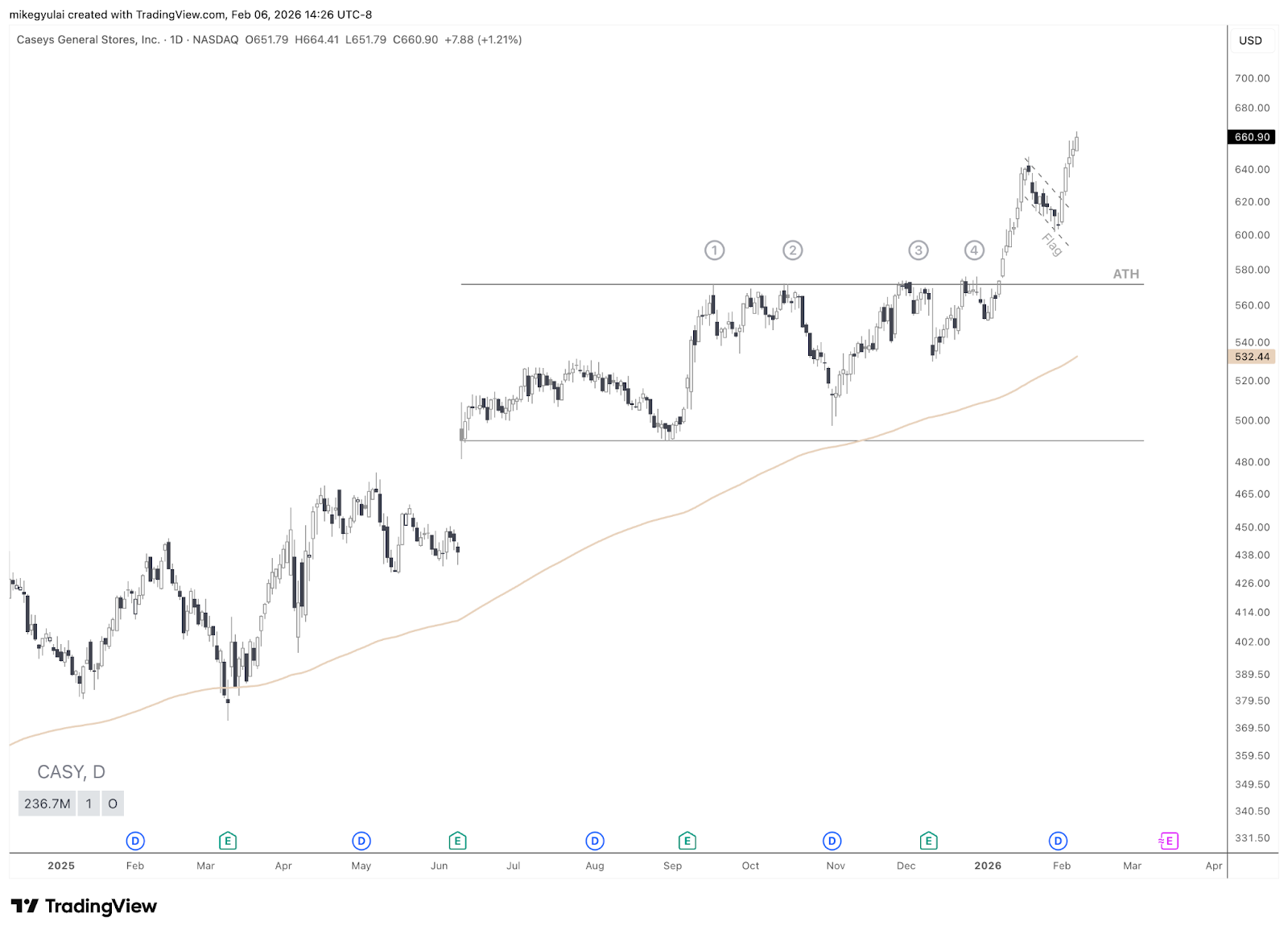
First, Macro Ops portfolio position Caseys General Stores (CASY) completed a small Flag on Monday and rallied the remainder of the week.
And second, East West Bancorp (EWBC) completed a High Base on Friday after consolidating above the breakout boundary for nearly two months.
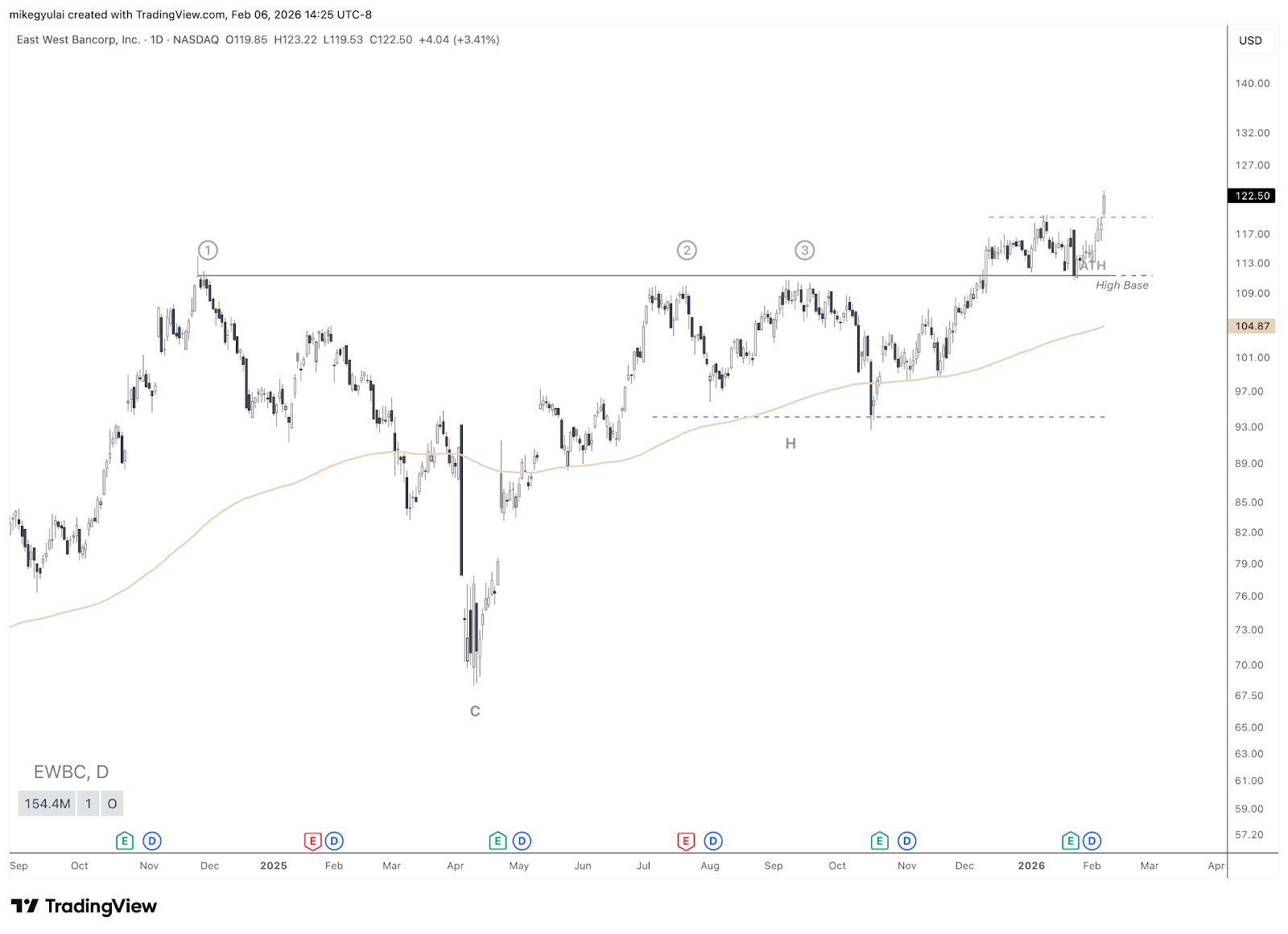
HURN’s Flag, covered last December, played out beautifully. As did CASY’s this week.
Will EWBC?
There is no way to know.
But such setups offer everything a technical trader could ask for: repeatedly identifiable asymmetric bets where a meaningful risk point can be defined.
The pauses that refresh
For the first time in months, the number of setups in my screeners is shrinking rather than growing—not because setups are failing or morphing, but because so many are following through.
Here are the names I’m watching going into next week:
Active watchlists, real-time trade alerts, and live portfolio tracking are reserved for members of The Collective, our premier service offering discussions on high-level theory and performance, differentiated research, and a global community of serious traders and investors dedicated to mastery. Learn more about The Collective here.