



Markets have reached levels of extreme uncertainty. I can see it in the cascading conditionals on social media. I can feel it in the chat rooms.
As the cone of possibilities widens its jaws, it swallows our footing. Our need to know rushes to the surface. Should I be long here? Hedged? Flat?
There’s a part of you looping on unknowable outcomes. Minute after minute, day after day. Inhaling the headlines, refreshing the feeds, dredging the torrent for the data point that will finally reveal what should be done.
And there’s another part, connected to what’s actually unfolding before it becomes intellectualized, that already knows how you should be positioned.
The part that knows is not concerned with benchmarks. It’s not the voice ready to pounce on you for being “trapped” by a bear-market rally or “shaken out” by a V-reversal.
Those voices are your personality defending something—your competence, your identity as a trader, your need to not look foolish. They write the story you tell yourself about your actions.
The part that knows sits below the story. And before any probabilities are assigned, before any analysis is compiled, it simply knows.
Accessing it requires stepping out of the defended posture. The part that needs to prove it saw it coming. That it didn’t get fooled. That it beat the benchmark.
It requires curiosity instead of certainty. Wonder instead of worry.
Wonder about this moment in market history: 100% unique, impossible to backtest or probability-weight into submission.
Audit your posture right now. Is it wide and curious? Or narrow and defended?
One part aches to know. The other already does.
Loosey Goosey
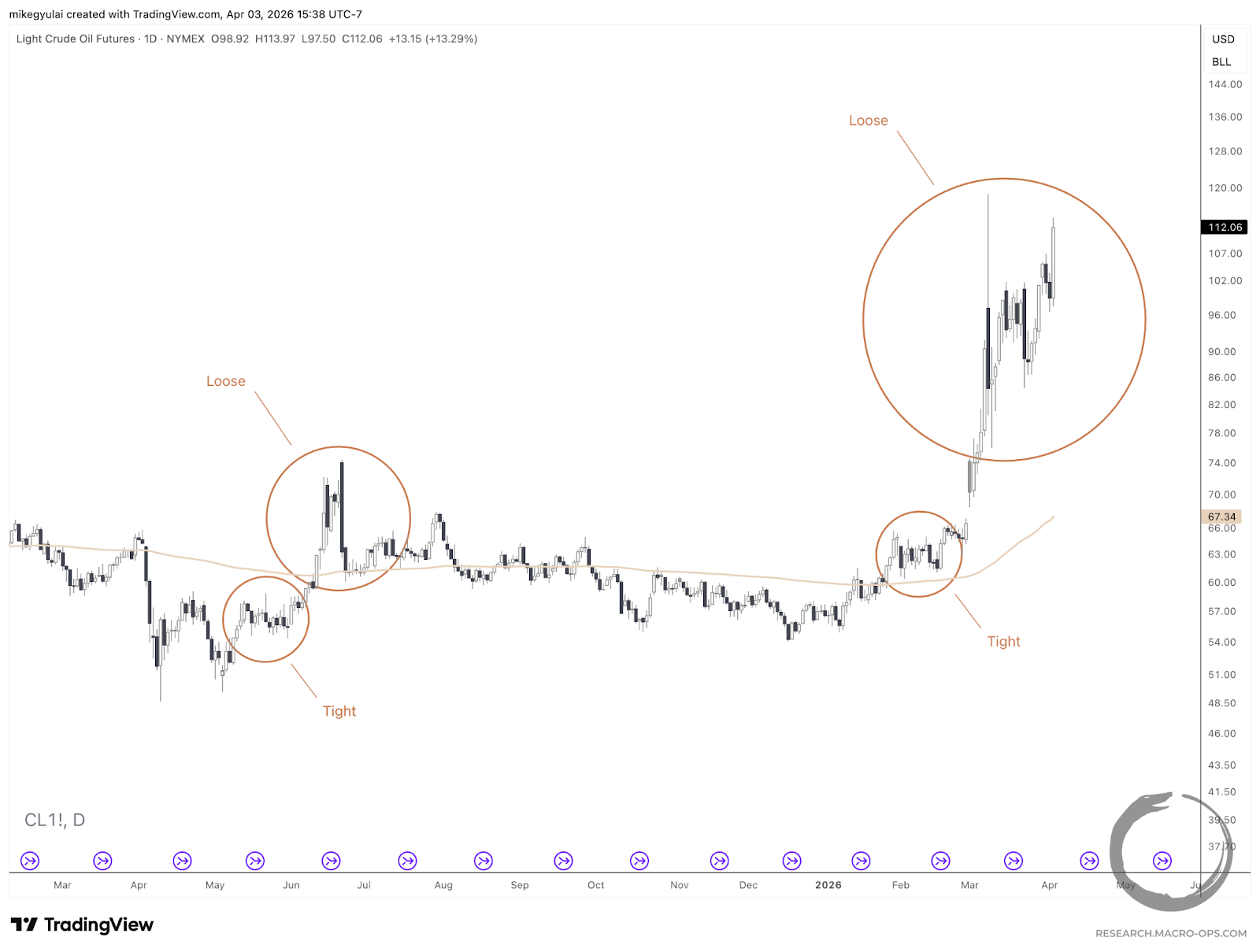
Buy ‘em tight, sell ‘em loose. So goes the swing trading maxim.
It’s “tight” price action that allows swing traders to set tight stops, put on meaningful size, and attempt to capture significant price expansion. When that “tight” price action becomes “loose,” it’s not the time to put on risk. It’s time to take it off.
We discuss this internally at Macro Ops often: our highest expectancy trades are ones taken on moves out of compressed price action—”tight” ranges on the charts.
And we tactically implement fast-moving trailing stops when price reaches elevated ATR levels beyond a key moving average, systematically selling “loose” price action.
The irony is that interest in specific stocks or commodities runs just the inverse. When price action is tight, it’s seen as too boring to be of interest.
And then when price gets loose? Everyone wants to speculate on the next big leg.
Right now, there is a ton of interest in gold, oil and commodities. I understand there are important economic implications at play here.
But from a purely swing trading standpoint, these charts are way too loose to offer much in the way of asymmetric risk-to-reward according to my playbooks.
Over the last month, we tracked the price compression in the Nasdaq that broke down last week:
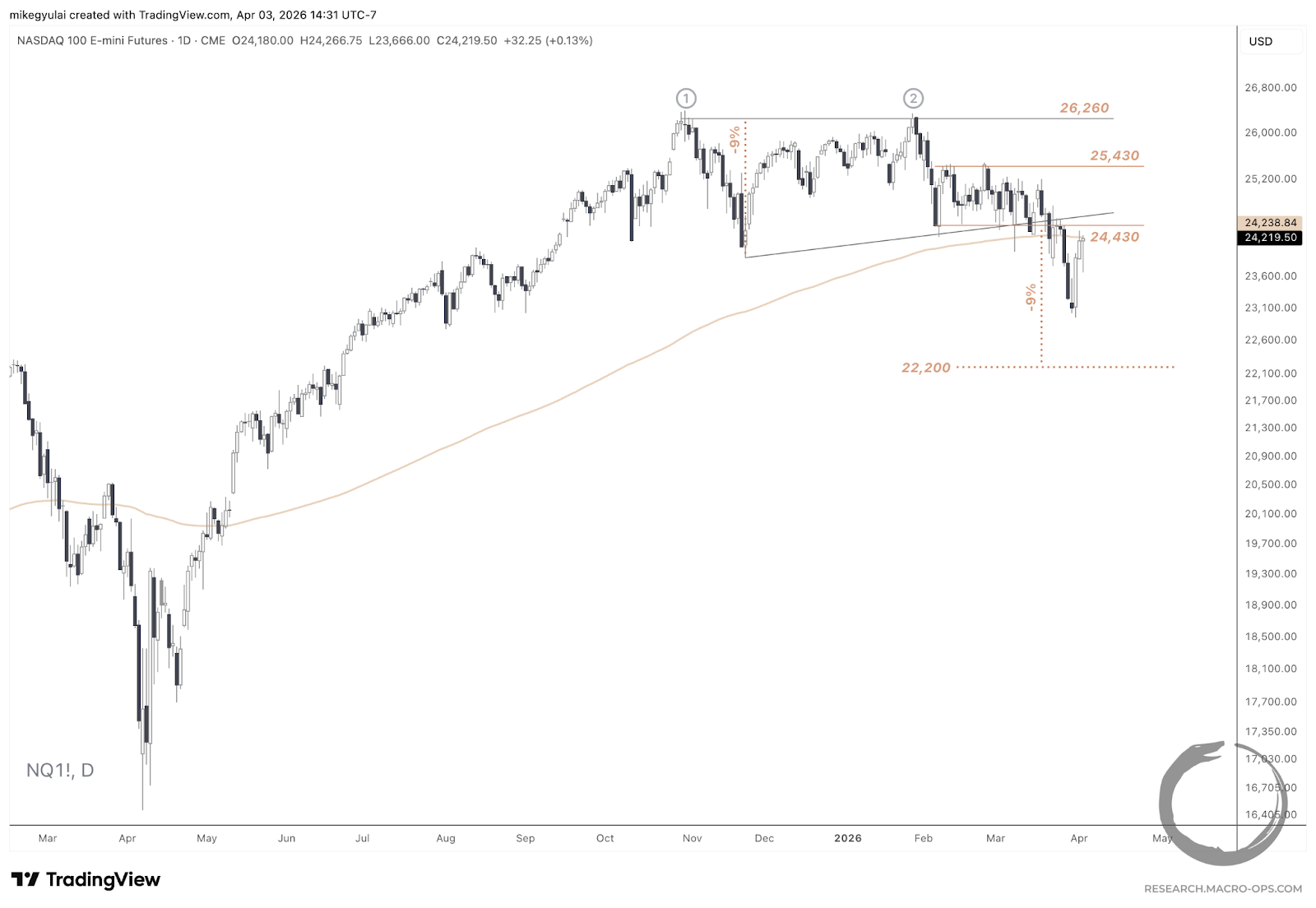
This week, price bounced right back to the converging resistance of the 200EMA, lower trendline, and compression range.
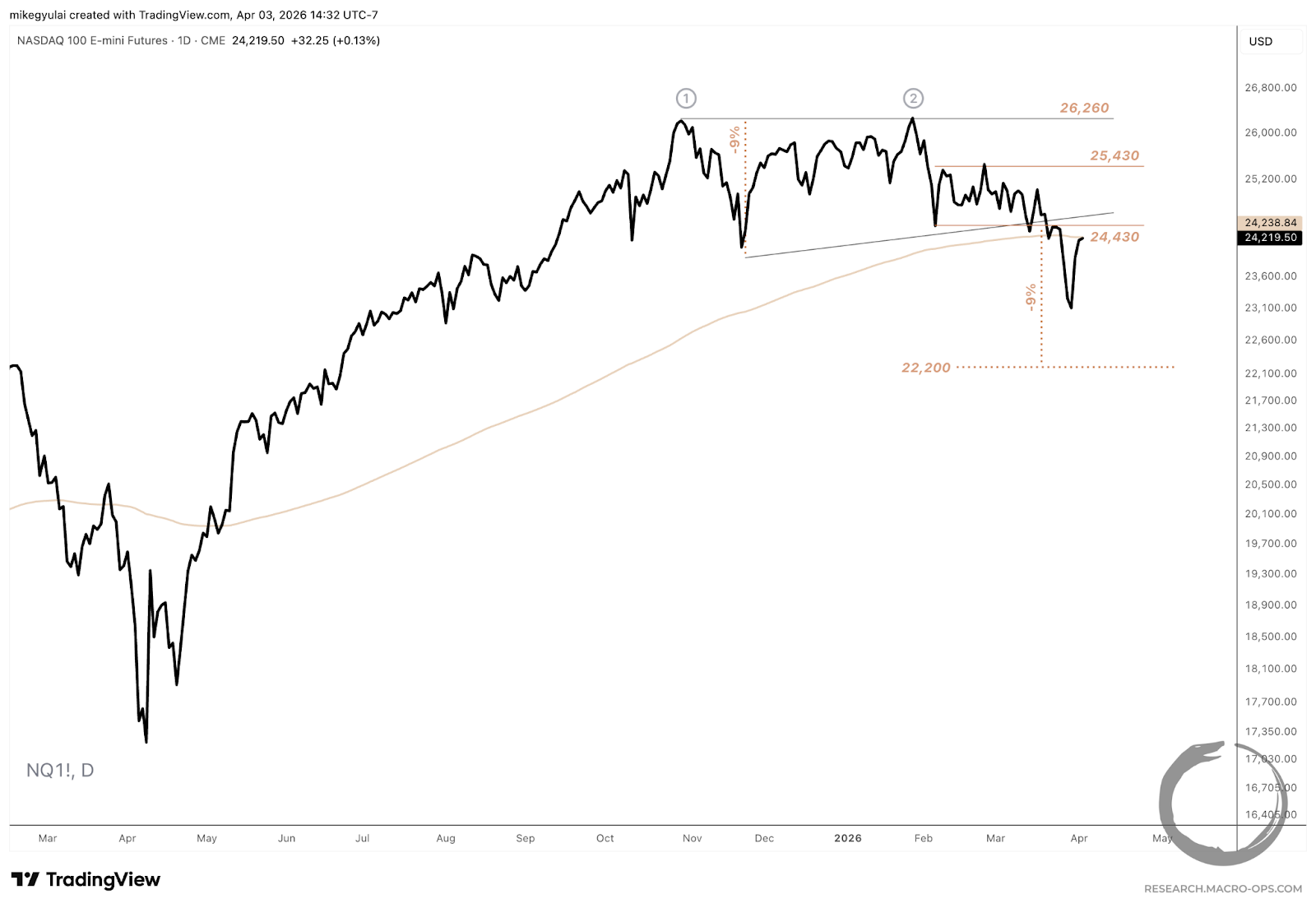
The Nasdaq was tight, now it’s loose.
This is even more apparent on the closing price line chart:
More interesting to me in the equity world is the Russell, which has held its “tight” price compression right at the convergence of its 200EMA and multi-point trendline.
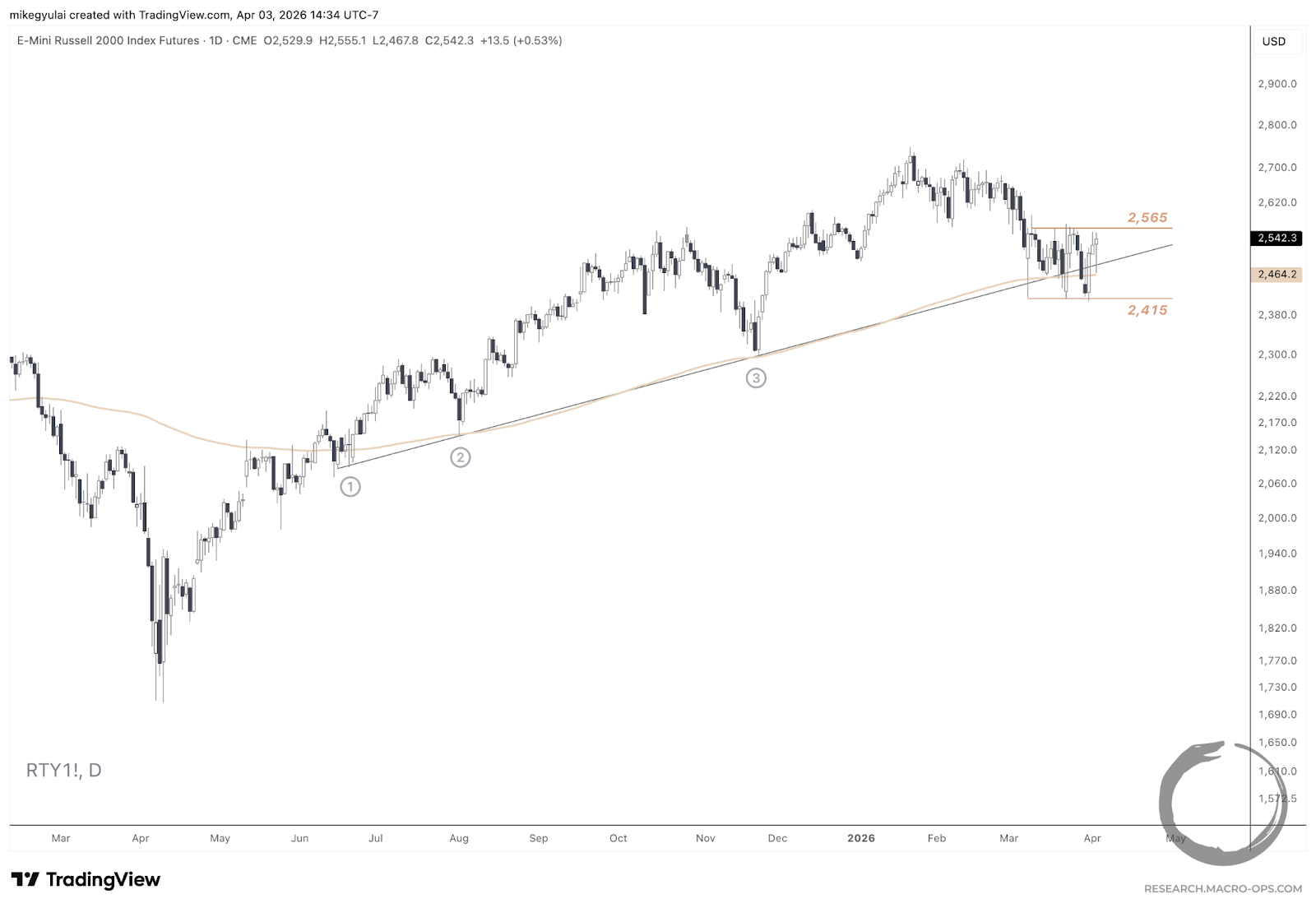
While the Nasdaq could whip around from here irrespective of the next intermediate move for equities, the Russell may give a cleaner read when it expands from this compressed range.
Relative Strength
If the next direction in equities is up, there are a few names that jumped out as exhibiting particular strength over the past two weeks of turmoil.
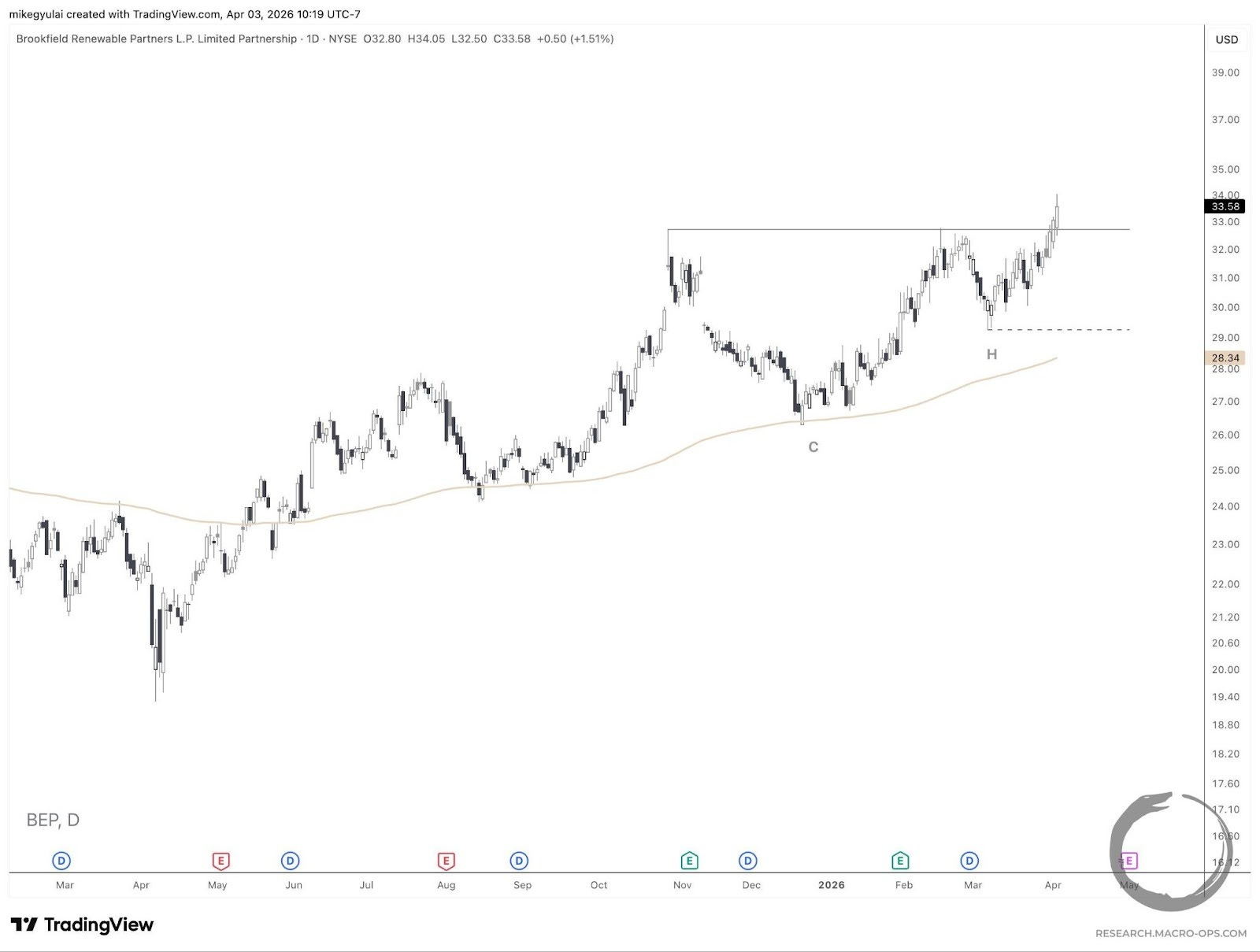
Brookfield Renewable Partners (BEP) completed a Cup & Handle Continuation on the daily:
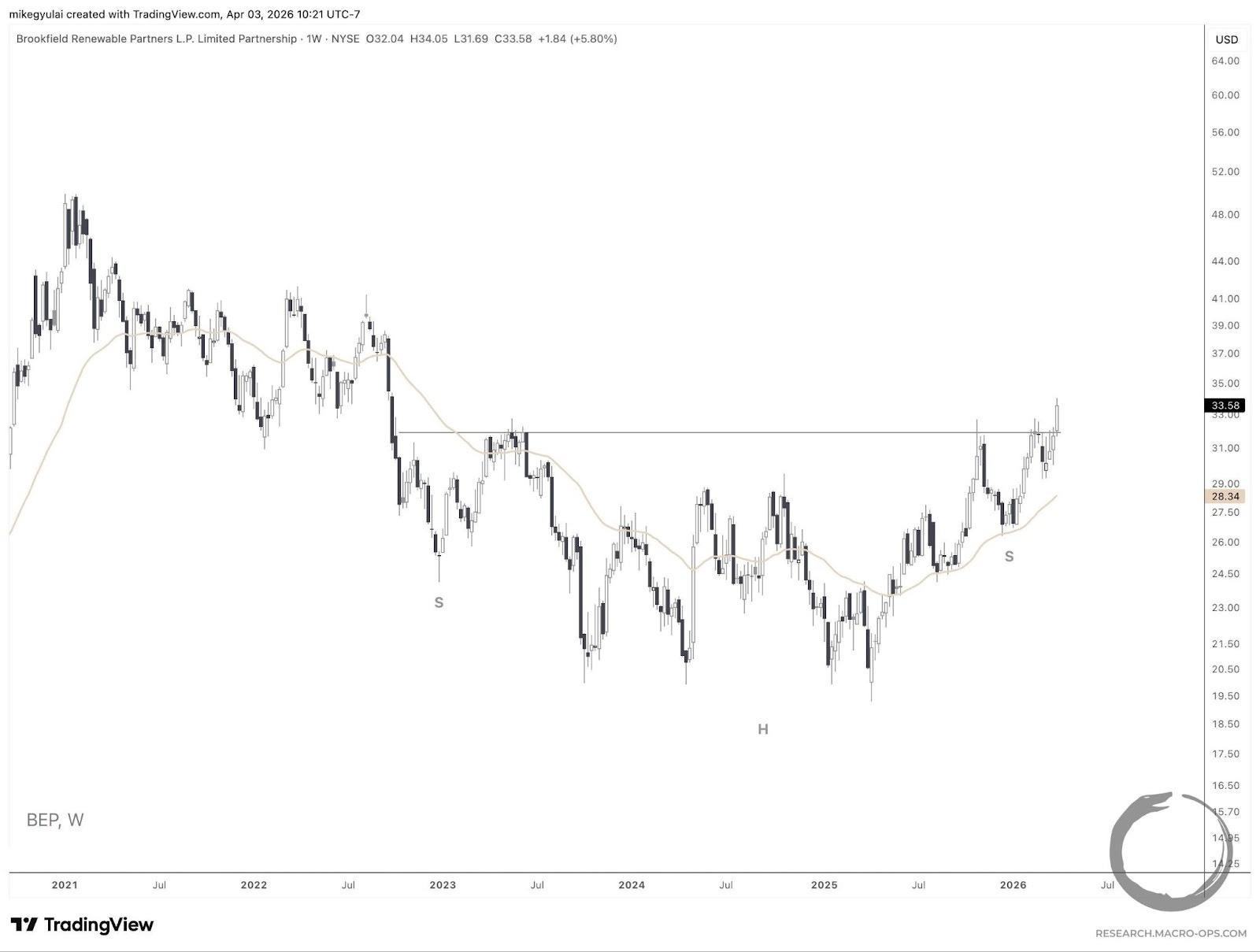
And this corresponds with completion of a massive Head & Shoulders Bottom on the weekly:
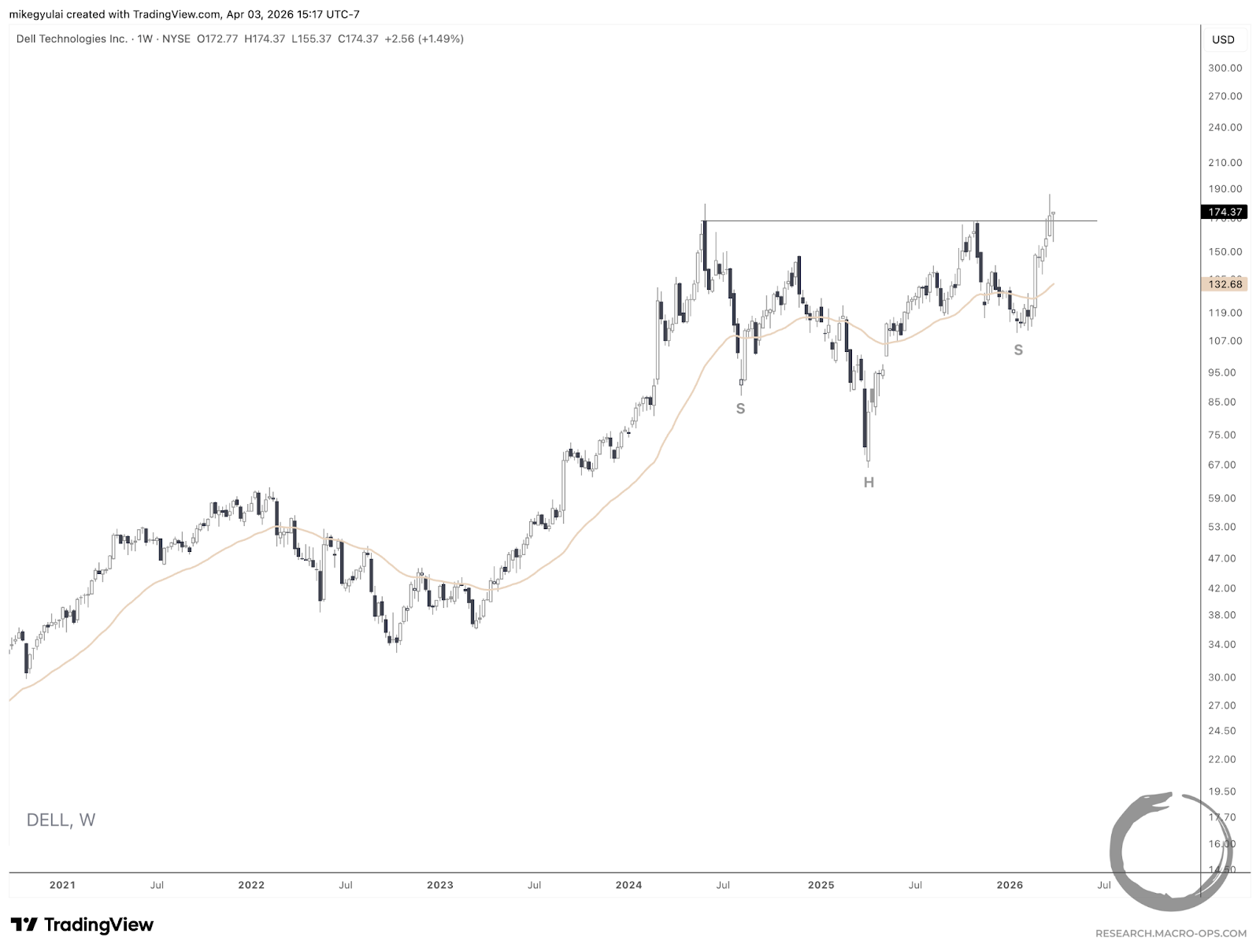
Dell Technologies (DELL) is threatening to complete an equally massive Head & Shoulders Continuation on the weekly:
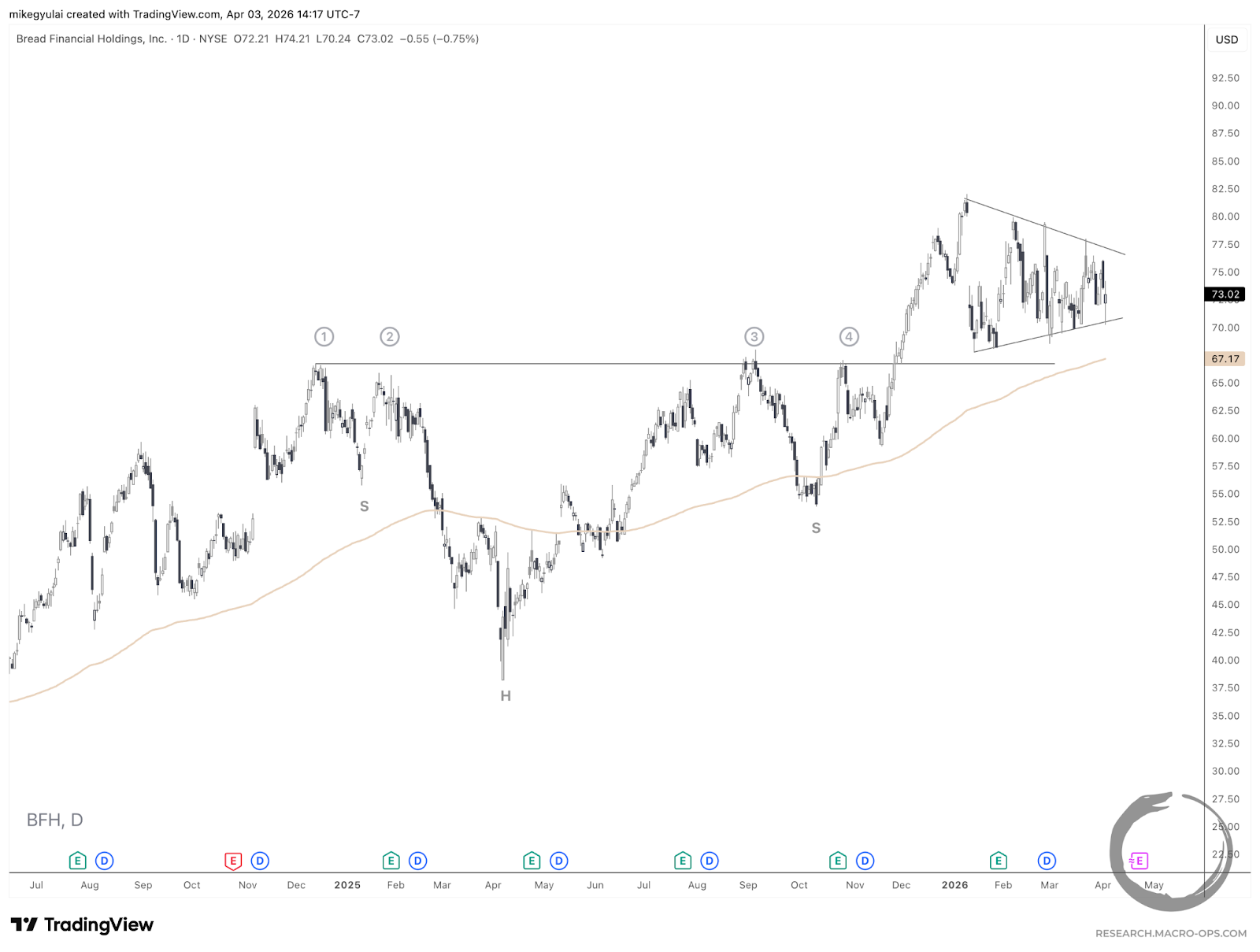
And Bread Financial Holdings (BFH)—featured from the very first issue of This Infinite Game—has held its breakout from a year-long Head & Shoulders Continuation pattern, and formed a Symmetrical Triangle consolidation above the breakout level.
The Pauses That Refresh
There are a number of patterns that have held their consolidations, as well as many opportunities to play on the short side or between range boundaries.
Here are the names that caught my eye during this week’s screen:
Active watchlists, real-time trade alerts, and live portfolio tracking are reserved for members of The Collective, our premier service offering discussions on high-level theory and performance, differentiated research, and a global community of serious traders and investors dedicated to mastery. Learn more about The Collective here.