



Lance Breitstein’s interview with Kenny “Shark” Sharkness, the number one trader at SMB Capital, crossed my desk this week. In it, Lance asked Shark about the largest drawdown of his career: the prolonged 2022 bear market in which the majority of his strategies stopped working.
Shark offered the tactical adjustments he made to claw back to his high watermark. But Lance pushed him on mindset—on how he endured an extended losing streak unlike any he’d experienced before or since.
His response:
“It wasn’t great. It wasn’t as fun anymore. But I always enjoy the challenge, even in the setbacks. ‘How can I figure this out?’ is part of the fun. And, additionally, I always separate trading from life. I had my family, I had a young baby, [I had] my friends. So at the end of the day, I always do my best to try and leave it at the screen and enjoy life elsewhere, and realize [trading’s] not everything.”
So many of us channel our identity fully into trading—a profession that promises immediate, measurable, objective proof that we are who we believe ourselves to be. One who outthinks, outmaneuvers, and outperforms in any domain we touch.
When the inevitable drawdowns occur, those whose sense of self is fully entwined with their PnL can feel their very existence is under threat. The body responds as if it must literally fight for survival, flooding us with panic and blinding our perspective. From that state, maintaining the open, curious mindset Shark speaks about becomes impossible.
They say, “don’t trade with money you can’t afford to lose.“
Just as important: don’t trade with an identity you can’t afford to lose.
What’s in a name?
In the Comm Center this week, Collective members had a good laugh over the “Chair with Ottoman” pattern that formed on Kansas HRW Wheat futures.
If you haven’t heard of the Chair with Ottoman, you’re not alone. You won’t find it in either of the foundational works on Classical Charting by Schabacker or Edwards & Magee.
Instead, this pattern is an original of Peter Brandt.
I’ve never actually seen Peter formally define the Chair with Ottoman pattern. Instead, I’ve come to my own understanding of this bottom reversal pattern through Peter’s many visual examples. For me, the defining characteristics are as follows.
The pattern begins as a downtrend consisting of large, volatile swings. The turn of each swing is relatively sharp. Price spends little time at any specific level, representing a lack of consensus by market participants.
Then, following the last swing high, the sequence of large swings is abruptly interrupted. Rather than turn over and put in the next swing low, price appears to find a floor.
Volatility drops as market participants come to consensus. Where the next large downswing should have occurred, a small consolidation pattern forms—often a rectangle. This consolidation is the “ottoman” to the prior downswing’s “chair.”
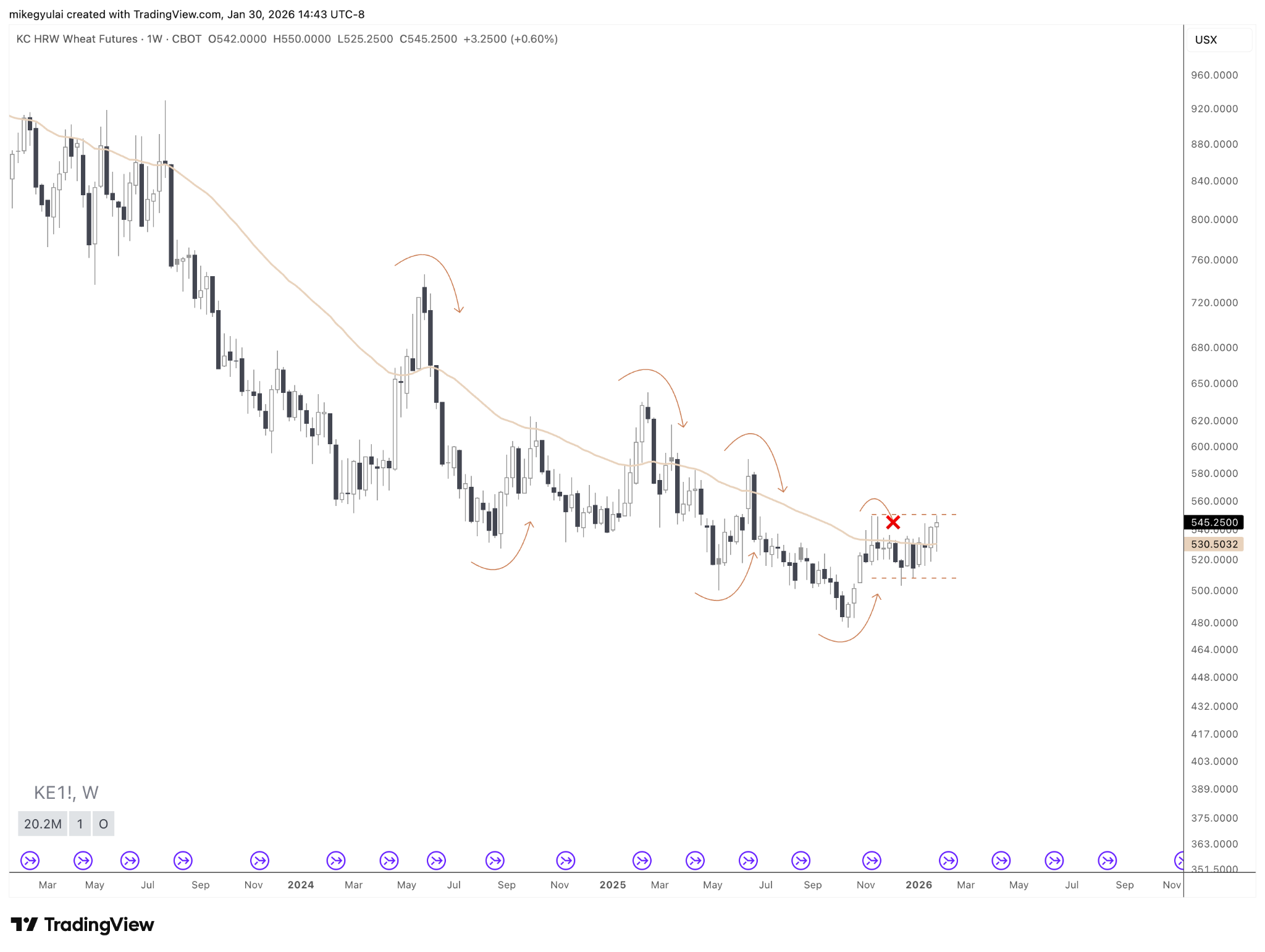
Squint your eyes and use some playful imagination, and you’ll be able to spot the profile view of a recliner and accompanying footrest in the last downswing and subsequent price consolidation.
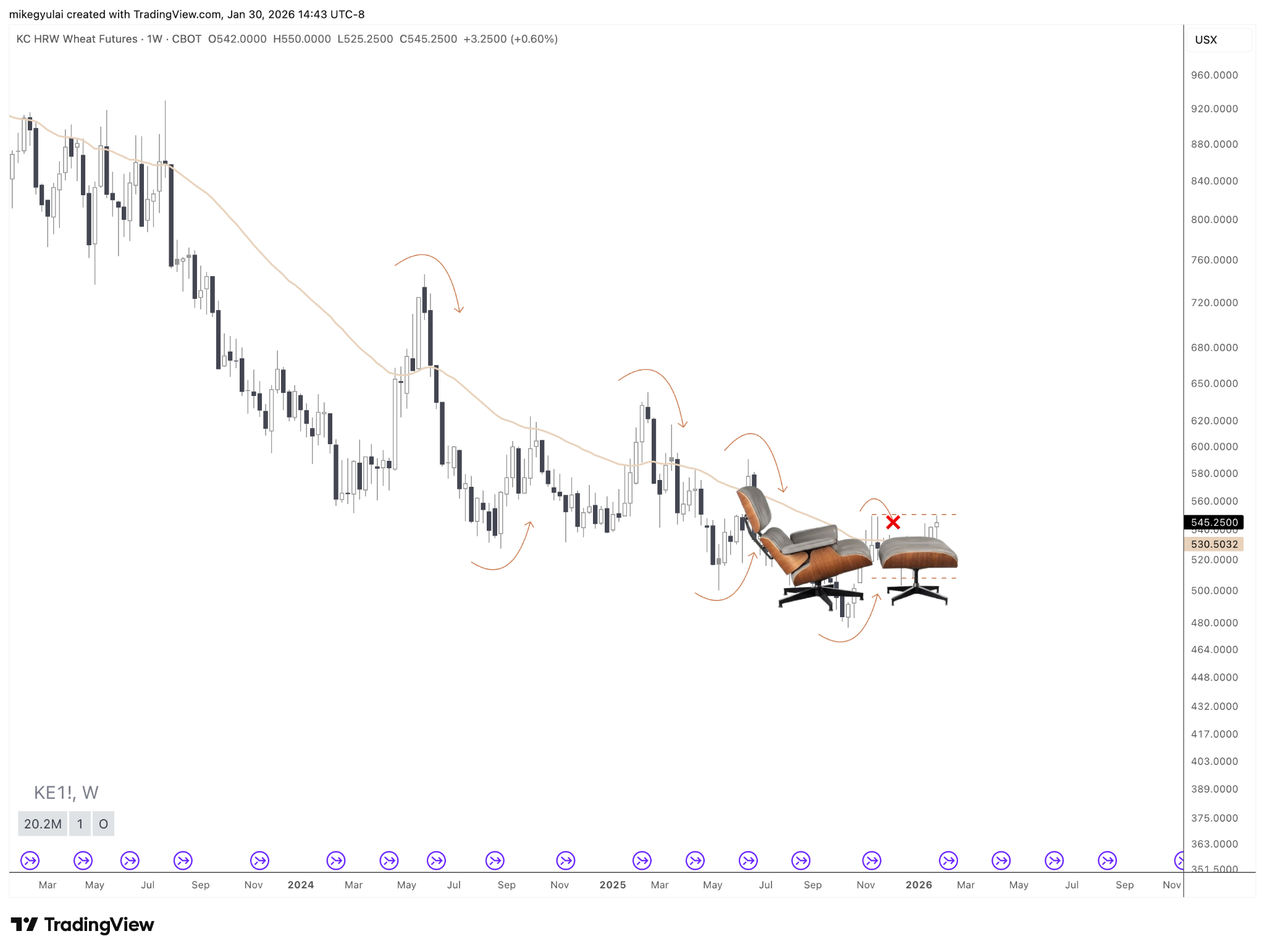
Peter spots this pattern in commodities often enough to dedicate a name to it.
While commodities are not a major asset class for my trading, I’ve found the primary characteristics of this pattern—the abrupt change in character followed by a low-volatility consolidation—to be equally useful in other asset classes.
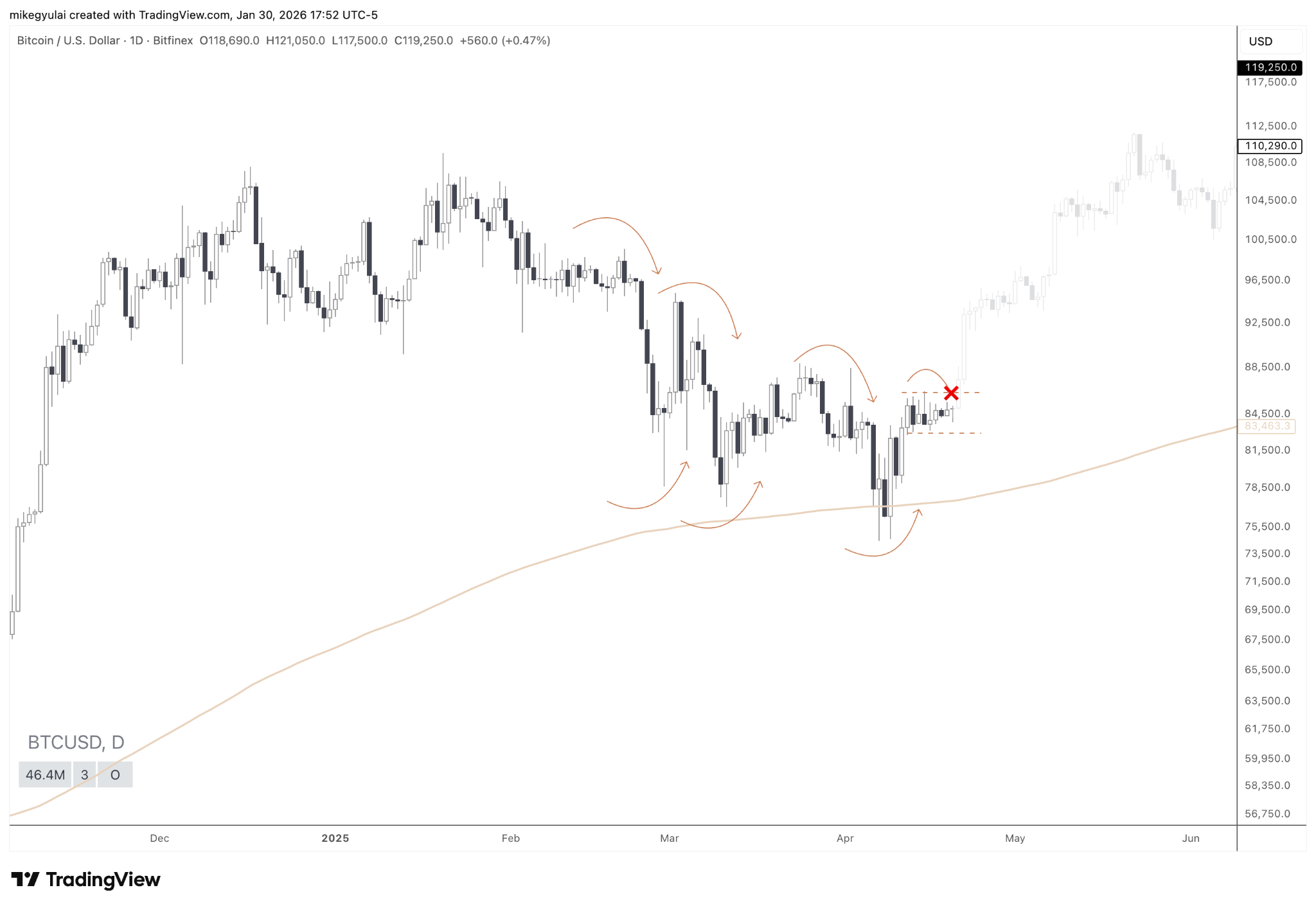
Two of my favorite examples are BTCUSD’s local bottom last April, and the definitive regime shift in equities from bear to bull in early 2023.
Let’s take a look back at each …
In December 2024, BTCUSD finally hit the $100K milestone. Then, as 2025 began, BTCUSD lost $100K. Then it lost $90K. Then $80K.
Was this it? Was the top in for the cycle?
Debates swirled regarding institutional demand, liquidity, and the four-year cycle. My guide, as always, was price. And in mid-April, a small change in character appeared.
Rather than put in a new swing low, price appeared to find a floor. Volatility dropped as market participants came to consensus. Where the next large downswing should have occurred, a small consolidation pattern formed.
BTCUSD then put in its next leg to $120K.
Turning to equities, SPY experienced a series of volatile downswings throughout the 2022 bear market. The market was characterized by overnight gaps, and dramatic reactions to news—especially CPI prints and FOMC meetings.
Then, in January 2023, that volatile sequence was interrupted. What followed was a multi-month, low(er)-volatility consolidation.
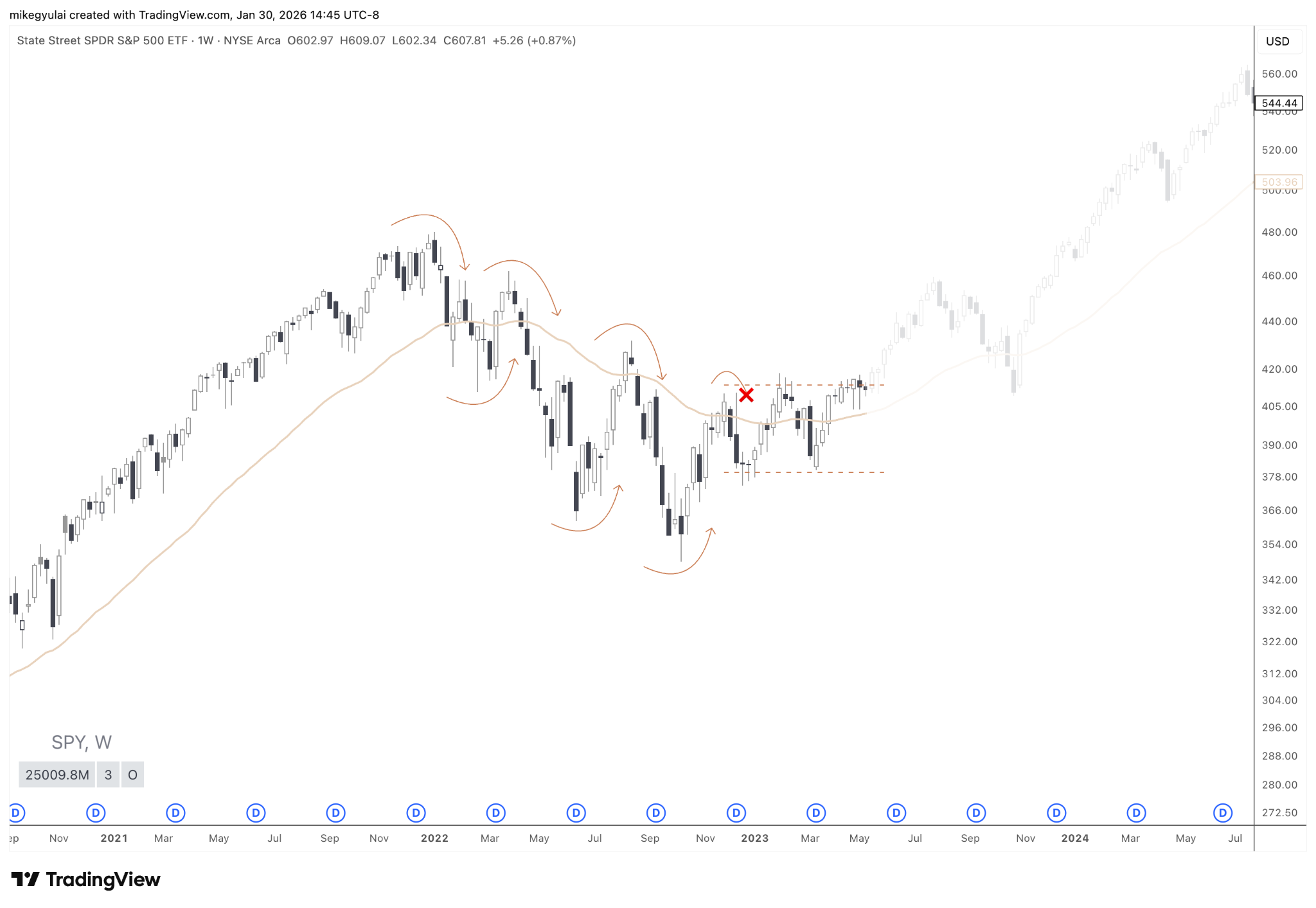
It was in large part this change in character—the “ottoman” to the final downswing’s “chair”—that gave me the conviction to declare the bear regime in equities officially over.
We’ve been in a multi-year equity bull since.
Whatever you name it, I encourage you to look for these characteristics in the markets you follow: volatile downswings, a pattern interrupt, a low-volatility consolidation. They offer excellent asymmetric, risk-defined trading opportunities.
The pauses that refresh
Currently in my screens, there is a mix of consolidations at their highs, threatening to breakout, and those at their lows, threatening to breakdown.
Here are the setups that have my attention going into next week:
Active watchlists, real-time trade alerts, and live portfolio tracking are reserved for members of The Collective, our premier service offering discussions on high-level theory and performance, differentiated research, and a global community of serious traders and investors dedicated to mastery. Learn more about The Collective here.
Brilliant piece. The distinction between trading outcomes and personal identity is something Ive wrestled with during rough patches. When positions go south, it's wild how the brain instantly conflates P&L with self-worth. Keeping that seperation clear feels almost like havinga safety net for the psyche.