


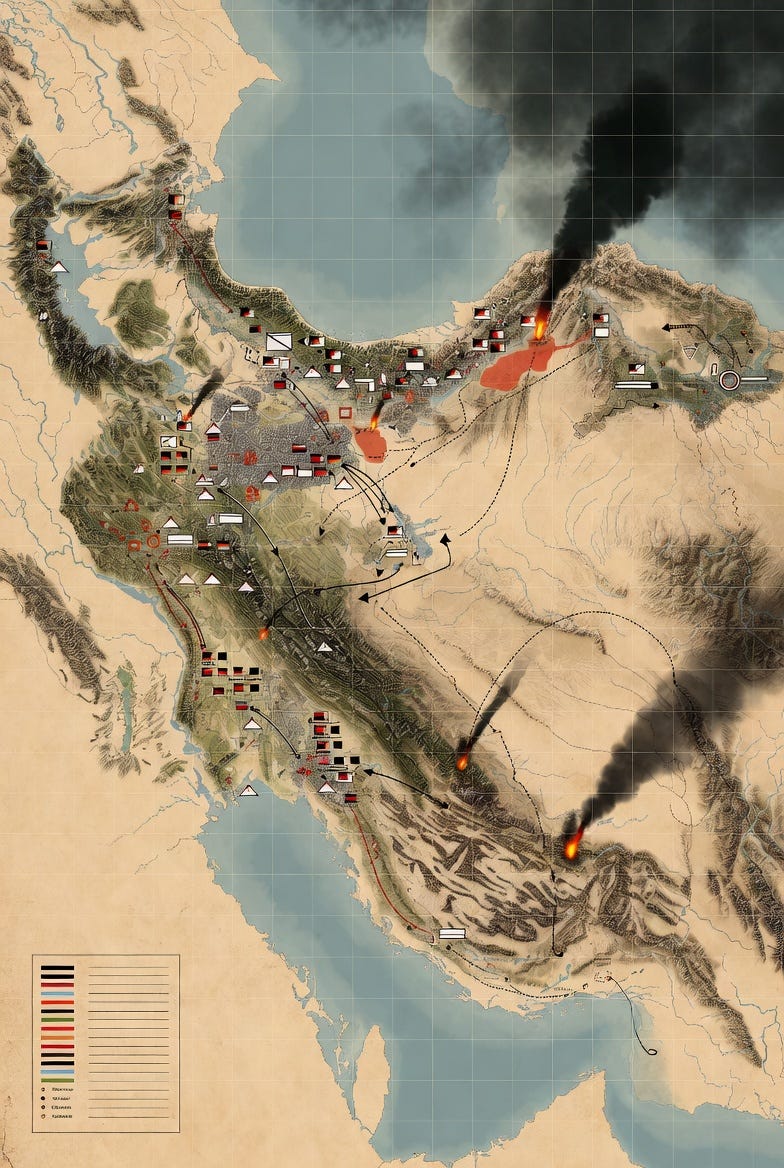
Today I’m sharing excerpts of an interview we conducted last week with members of our Collective and a former intelligence officer — someone who just left one of the three-letter agencies, where his entire focus was on Iran. It’s the most clear-eyed, unfiltered read on what’s actually happening there. I think you’ll find it worth your time.
But first, a quick share on why we were positioned for this before it all started.
John Arnold — one of the greatest energy traders who ever lived — was recently on Invest Like The Best. Great episode, highly recommend giving it a watch (link here).
In it, he credits his success to a concept he calls the best seat in the business. Not the best model. Not the most rigorous process. The best seat. What he meant was a self-reinforcing flywheel: the best economics let you hire the best people, the best people generate the best returns, the best returns attract more capital, more capital buys better data and better systems — and around it goes.
Until you’ve built something nobody else can replicate. The best perspective, the most information, the most advanced tools in the game. All of it compounding on itself.
That’s what we’ve spent the last decade building at Macro Ops.
My seat came out of the intelligence world. I spent years in it, kept the relationships, and kept listening. That network told us to go long oil and commodities heading into this conflict. It told us to cut our entire equities book last week and derisk. We’re up over 40% year-to-date. That same network had us positioned ahead of Russia’s invasion of Ukraine — long wheat, long European energy — while the consensus was still debating whether Putin was bluffing.
Brandon’s seat is different. Every week he sits down with top hedge fund managers and CEOs of companies we’re actively researching. Not once a quarter. Every single week. That’s a proprietary data source most investors will never have access to.
And then there’s the Collective itself — a Slack where professional fund managers and sharp independent investors share what they’re seeing from their own corners of the market, in real time, from genuinely different vantage points. Each member’s network and perspective feeds the whole. That’s the flywheel.
Druckenmiller said recently that after nearly thirty years, macro is back. We’ve been saying the same thing. We’re in the Fourth Turning — a convergence of technological, economic, and geopolitical forces that’s only going to intensify from here. What’s happening in Iran right now isn’t an isolated event. It’s the opening act of something much bigger.
In an environment like this, your seat is everything.
We’re opening enrollment to the Collective this week.
[Get your seat here.]
Today I’m talking with an old friend of mine, who, at his request, will remain anonymous and so be referred to as Mr.X in this interview. Mr. X has a long and storied career in defense and intelligence. He just recently left one of the three-letter intelligence agencies, where his focus was Iran.
We got on a call to talk through the Iran situation — what’s really driving it, who’s miscalculating and how badly, and what the realistic outcomes look like over the next six to twelve months. I had a list of questions from MacroOps readers (a sharp group, as always), and we just went through them. What follows is the edited version of that conversation.
The picture Mr. X paints isn’t particularly flattering for American strategic coherence. But it is, I think, an honest one. His bottom line: the US got suckered into this, Iran blundered spectacularly, regime change is a fantasy, and the most likely outcome is a messy negotiated off-ramp that leaves Iran diminished but intact. He puts the catastrophic scenario — a rogue IRGC igniting a full Gulf conflict — at under 20%.
Make of that what you will.
The Macro Picture: How the US Got Pulled In
Alex: Before we get into the reader questions — just give me your overall read. What the hell is going on, and why are we here?
Mr. X: Where do you even start. Look — this is a reckless endeavor that we got pulled into. It reminds me of 1950s, when Churchill basically dragged the US into toppling a semi-democratically elected Iranian government. We installed the Shah, and it’s been a quagmire ever since. Here we are doing it again — getting sucked into a conflict thousands of miles away where we have no real vested interest. Every Gulf country told us not to do this. We did it anyway.
Alex: So what’s the actual motivation?
Mr. X: We’re backing Israel in an effort to topple the regime. Netanyahu sees this as his legacy — getting rid of the Islamic Republic once and for all. But regime change is wishful thinking. Their apparatus is too strong. You take out the Supreme Leader, and the baton just passes to the next one. You’re still looking at a religious theocracy. The only real shot at something different would be an internal revolt — and even then, it would have to come from the Artesh, the regular army, rather than the IRGC.
Alex: Explain those two organizations for readers who might not be familiar.
Mr. X: Iran has two parallel military structures. The Artesh is the regular army — professional officers, many of whom trained at US war colleges during the Shah’s era. Khomeini didn’t trust them when he took over, so he created the IRGC specifically to protect the revolution. Two separate armies, very different cultures.
The history between them is brutal. When the Iran-Iraq War started in 1980, the regime had thrown most of the experienced Artesh officers in prison. Then they realized they had no one with actual command experience to fight the Iraqis. So they pulled the officers out of prison, promised them freedom after the war — and then executed most of them right after the ceasefire. That’s the kind of regime we’re dealing with.
Iran’s Spectacular Miscalculations
Alex: You said the Iranians screwed up royally. Walk me through it.
Mr. X: The DIA estimated Iran had roughly 3,000 ballistic missiles. If you’re going to use them, you concentrate fire on targets that matter — Israel and Bahrain, where the US Fifth Fleet is based. Instead, Iran fired nearly a thousand missiles at Gulf countries. The UAE shot every single one of them down. What Iran effectively did was let the Gulf States subsidize Israel’s defense.
And people don’t appreciate how layered the Gulf State missile defenses are. The UAE isn’t just running American tech — they have South Korean and Russian anti-missile systems as well. Iran spread their salvos so widely they even attempted to hit Turkey, which is a NATO member. You want Article 5 invoked against you? I don’t see NATO nations joining the conflict; however, they can certainly start deploying assets to assist on the defensive end, which France and UK have already started.
Their internal talking point before this started was: if we go down, everyone goes down with us. They tried to execute on it and failed completely. The Iranians are, frankly, hyper-irrational in their strategic decision-making. You know that concept in the Steve Jobs biography — the reality distortion field? These guys have a collective version of it. They genuinely believe that launching a missile at Israel, even after losing their Supreme Leader and their top commanders, constitutes a victory. I remember them pulling that logic after Soleimani was killed in Iraq and when Nilforoushan was killed in Lebanon.
Alex: Where does that mentality come from?
Mr. X: It’s a fundamental pillar of Shia identity — always being the underdog. When Khomeini took over in 1979, one of the revolution’s core tenets was to export it globally, which put Iran on a permanent collision course with the Gulf monarchies. They’ve been running proxy wars against those kingdoms for decades. Everyone knows it. No one says it out loud. But the IC and the military were not surprised when Iran started lobbing missiles at Gulf countries — they’ve been trying to destabilize those governments for years. They just severely underestimated how prepared those governments were.
And the diplomatic blowback has been severe. Before the attacks, Gulf countries were telling Israel they couldn’t use their bases. After Iran crossed the line by launching missiles against them, some of those same countries said: ‘okay, you can use our bases.’ Iran handed their adversaries the political permission slip to go fully on offense.
The Killing of AFGS Bagheri and Israel’s Decapitation Strategy
Mr. X: The single biggest mistake before all of this was killing AFGS Bagheri. He was probably the second most powerful figure in Iran after the Supreme Leader, and he was a relative moderate. Clean-cut military bearing — you’d notice him immediately in a lineup of Iranian military generals because he didn’t have the beard, didn’t have the Revolutionary look. He was the kind of figure the US could have worked with. Not regime change, but a managed transition to someone we could at least dictate terms to.
But Israel’s strategy — same as what they did with Hezbollah — is kill from the top and keep going all the way down. You elect a new leader, they go after him too. It’s been effective tactically, but it has foreclosed any path to a moderate successor.
GCC Stability and the Real Regional Risk
Alex: One of our readers asks: how likely is it that GCC governments themselves get destabilized — infrastructure damage, desalination plants, food imports slowing?
Mr. X: Not likely at all. These are Sunni kingdoms that deeply despise the Persians, Iranians, and Shiites — three separate reasons to hate them, as I like to say. Ballistic missile attacks on their territory aren’t going to fracture these governments politically. It is likely going to produce a massive rally-around-the-flag effect. The GCC was literally formed because of Iranian territorial aggression. Some of these countries are now openly discussing offensive operations against Iran.
The real risk isn’t GCC destabilization. It’s the IRGC speedboat navy. Iran’s conventional navy has been largely wiped out, but those small, fast, hard-to-track craft in the Strait of Hormuz — which is only about 21 miles wide — can do serious economic damage through sheer harassment. If they move to close the strait, the Gulf States retaliate. That’s the scenario that could spiral into a prolonged Sunni-Shia regional conflict — especially if the US steps back and leaves Israel provoking both sides.
Iraq is Iran’s only remaining satellite state, and even they’re staying out of this.
Off-Ramps and the Martyrdom Trap
Alex: Is there a martyrdom trap here — does sustained bombing actually strengthen the regime internally?
Mr. X: You’ll get a temporary rally-around-the-flag bump, sure. But I think an off-ramp gets offered within a month or two, and Iran takes it. They almost capitulated a year and a half ago — they knew they had basically no air defenses. The Israelis were literally flying sorties past Tehran just to troll them, and Iran couldn’t do anything about it. In public they’ll say death to America, death to Israel — that’s for domestic consumption. Behind closed doors, the Iranians will take the off-ramp that is offered. This is the first time their counter-attack actually killed US military members, they will spin this as their reason for victory and take the off-ramp.
Alex: Would Israel even accept a ceasefire without regime change?
Mr. X: Yes, I think so. They’re practical at some level, because full regime change is simply not going to happen. The IC’s probability on that is effectively zero — 0.00001%, if you want to be precise. Israel’s real goal is permanent destabilization. If Iran is consumed by internal chaos and can’t fund proxies in Lebanon, Syria, and Gaza, Israel wins on the terms that actually matter to them. Both the US — through the Swedes — and the Israelis maintain back channels with the Iranians. And Oman was actively mediating right before the bombing started. There were reportedly positive developments. Then the bombs dropped. Make of that what you will.
Alex: What does the US off-ramp actually look like?
Mr. X: If these were two fully rational actors, a deal would already exist. The most credible US pressure point might simply be telling Israel: we have nothing left to give you. We’ve been transferring Patriots and THAADs to Ukraine — our stocks were already depleted before this started. They’re now talking about pulling batteries from South Korea and Japan, which compromises those theaters considerably. At some point the US says ‘we can’t support you any further,’ and that creates the conditions for negotiations. There’s also apparently already a Trump back-channel to Tehran that Netanyahu caught wind of and tried to shut down — which tells you everything about the internal tensions in this coalition.
Missiles, Launchers, and the Drone Problem
Alex: Iranian launches have slowed. Is that a strategic decision or degradation of capability?
Mr. X: It’s the latter. We have the ability to detect a launch almost instantaneously, and those transporter erector launchers get bombed within minutes. I’ve personally seen probably fifty videos of their launchers getting taken out. You can have a thousand missiles and fifty launchers — take out the launchers and the missiles will just sit there. Israel has been bombing some of those underground storage sites continuously — the logic being if the bombs don’t kill whoever’s inside, the suffocation will. They did that when they went after Nasrallah, bombing the same bunker daily until the job was done. Ruthless, but effective.
By the numbers: Iran started with around 3,000 ballistic missiles, has fired over 1,000, faces a roughly 30% failure rate, and has lost a large share of its launchers. The math doesn’t work in their favor. And last year, Israel destroyed much of their domestic production infrastructure — the fuel mixture equipment has to be sourced overseas and takes years to procure. They can’t replenish at any meaningful rate.
Alex: What about drones? They reportedly have 20,000 of them.
Mr. X: Drones are the bigger long-term problem. Their launching platforms are more mobile and produce far smaller signatures than ballistic missiles — much harder to track and preemptively strike. And they’re genuinely difficult to intercept. Modern air defense systems are designed for fast-moving, high-altitude targets. Drones are like flying Honda Civics — slow, low, and irritating. Firing a two-million-dollar interceptor at a twenty-thousand-dollar drone is not a sustainable exchange ratio.
IRGC: Paper Tiger Abroad, Paranoid at Home
Alex: How effectively has Israel degraded the IRGC’s overseas capabilities?
Mr. X: Remarkably effective. The IRGC’s primary mission was always to export the revolution — build and sustain military structures in Syria, Lebanon, Iraq, and Gaza to encircle Israel. Since October 7th, Israel hasn’t just gone after Hamas and Palestinian Islamic Jihad. They’ve gone after everyone. The IRGC spent billions building military infrastructure in Lebanon over thirty years. It was wiped out in weeks.
That’s caused serious discontent within the Artesh, who feel that money should have been used to build actual military divisions rather than proxy militias that collapsed the moment they got bombed. And those proxies were paper tigers. Hezbollah fighters in Lebanon fled when the campaign started — they were there for the Iranian paycheck, not ideological conviction. The Iraq situation is almost comical. The paramilitary units treat their IRGC affiliation like a weekend drill. When missiles started flying, they were suddenly very busy with other things.
The command structure is in freefall. After they killed a senior Hezbollah commander, the IRGC was so short on qualified personnel that they had to pull a retired general out of retirement, but the poor guy got killed almost immediately. You can’t make this stuff up.
Hidden Capabilities and the ‘Ace Up the Sleeve’ Question
Alex: There’ve been persistent rumors — a nuke quietly provided by China, hypersonic missiles, some kind of hidden ace. Anything to any of it?
Mr. X: No. It sounds like the last days of Nazi Germany — ‘we have a secret weapon, we have V2 rockets, jet airplanes.’ They don’t have anything. And the dynamic that generates those rumors is actually instructive: the IRGC and Artesh are in constant budget competition with each other. Neither organization fully discloses its capabilities to the other because transparency could mean budget cuts. So they feed each other — and outside observers — a steady diet of exaggerated or fabricated weapons programs.
We just killed their Supreme Leader and nothing new has been deployed. That tells you everything you need to know about the state of their hidden capabilities.
The corruption compounds all of this. Commanders protect subordinates who are skimming money, because everyone is skimming money.
Revolution, Opposition, and the Shah’s Ghost
Alex: Consensus among analysts seems to be no viable opposition, revolution highly unlikely. Do you agree?
Mr. X: Completely agree. The regime has been systematically eliminating opposition figures for years. And here’s the thing — you only need about 5 to 10 percent of the population as armed loyalists to hold everyone else down. There’s no established political opposition. Every candidate for office has to be approved by the regime. Even former prime ministers who were deemed too moderate have been barred from running. There’s no infrastructure for a movement to attach to.
The Kurdish incursion from the north is essentially a sideshow. And as for rallying around the Shah’s son — look, the revolution happened because the Shah was corrupt and deeply unpopular. That was over forty years ago. Nobody credible is sitting in exile ready to step in. This government is going to remain. The most realistic outcome is a moderate, eventually rising within the existing structure.
The Domestic Threat: Iranian Sleeper Cells in the US
Alex: What’s the realistic threat of IRGC operatives or Hezbollah sleeper cells launching attacks on US soil?
Mr. X: Honestly? They’re a joke. I wish I could be more specific about how much of a joke, but their operational security is terrible — we catch most of their plots before they get anywhere. The Caracas route, where Hezbollah would fly operatives from Tehran to Venezuela, give them fake documents, and filter them into the US through the southern border — that’s been shut down. That was actually the real reason the US moved on Venezuela. Not cartel activity. Iran, Russia, and China were operating essentially unchecked in the Western Hemisphere and we put a stop to it.
They’ve been trying to kill about twenty targets on their Soleimani retaliation list since 2020. They’ve gotten nowhere. Their standard approach is to hire Pakistani criminals or German-Turkish biker gang members as cutouts. It has failed every single time. I’m not losing any sleep over Iranian sleeper cells in America.
The Strait of Hormuz: Can Iran Close It?
Alex: Can Iran actually close the Strait? And is it feasible for the US Navy to escort tankers through, or is the asymmetric swarm threat just too great for commercial insurers?
Mr. X: Iran has the capability to block it, yes. Even with a US naval concentration of force, you’d have escort convoys with five- to ten-mile gaps — and a fast speedboat can cover that gap and hit a tanker before anyone responds. No commercial operator takes that risk without government-subsidized insurance that pays out quickly, and even then you’re still losing the ship. The Iranian coastline is much longer than the strait itself; attacks can come from multiple vectors simultaneously. The market would price that risk accurately, and the answer would be: not worth it.
Iranian Financial Networks: Vast, Leaky, and Hard to Kill
Alex: If the US moves to freeze Iranian financial nodes, do they have a crypto or Beijing-backed workaround?
Mr. X: Their financial network is vast but extraordinarily disaggregated and inefficient. The IRGC doesn’t sell oil on the open market — they have shadow networks of operators who go directly to countries like Venezuela, India, and China: ‘Want to buy some oil?’ There’s no central node to take out. You can’t just sanction their central bank and cripple the whole system.
They’ve dealt in untraceable crypto — Monero and Dash — but mostly for stashing personal wealth, not funding operations. The old Lebanon pipeline, where couriers would fly in carrying bags of cash and hand them off airport-side without so much as a receipt, has been shut down. The inefficiency is staggering — couriers go missing with millions of dollars a couple of times a year. Sometimes they find them. Sometimes they don’t.
The two things worth watching: whether the UAE starts freezing Iranian assets held there, and whether Qatar gets fully flipped. Qatar is genuinely bizarre — they fund everybody. The US, the Taliban, al-Qaeda, ISIS, Iran — they just want to be friends with everyone and make sure the Saudis don’t get too powerful. If Iran’s miscalculation convinces Qatar to pick a side, that would meaningfully cut into Iran’s financial networks.
Why Is the US Really Here?
Alex: The administration’s stated reasons — payback for IEDs from a decade ago, nuclear threat reduction — doesn’t hold together. So what’s the actual US strategic goal here, if there is one?
Mr. X: Honestly, I don’t think the US had a coherent strategic goal. We got dragged in. The DoD’s operational vision is narrow: remove Iran’s ability to project naval force, ballistic missiles, or any meaningful threat beyond its own borders. They can probably accomplish that in two to three weeks — except on the drone side. China losing access to Iranian oil is a secondary benefit that the administration may now be leaning into, but it wasn’t the motivation.
Trump got suckered. He was sold a narrative that this would be a quick operation — a Venezuela-style decisive win, four or five days, Iran comes to the table from a position of weakness. That story hasn’t held up. And it doesn’t make sense on its face. We’re burning through stockpiles we need for other theaters. He ran on being anti-war. It’s not popular with the MAGA base. The IED rationale is dredging up grievances from ten years ago. The only explanation that actually coheres is: Israel called in a favor, and we said yes.
Alex: That’s a strange amount of influence for a foreign government to have over us.
Mr. X: It’s not just this administration. It spans at least the last forty-plus years. Ever since the one president who publicly questioned whether Israel should have nuclear weapons was assassinated, then 200 pounds of plutonium goes missing from a facility in Pennsylvania. Everyone else has fallen in line afterwards. Not trying to be conspiratorial; however, it puzzles the entire Intelligence Community as to why we support Israel so much.
Alex: I did not know that about plutonium.
Mr. X: Most people don’t. It’s not something people talk about. But it’s there if you look.
Base Case: The Next 3 to 12 Months
Alex: Walk us through your base case — and your worst case with a rough probability.
Mr. X: Base case: the US and Israel spend roughly the next month systematically destroying Iran’s military infrastructure, nuclear development capacity, and ballistic missile production and launch capability. We’re already using B-1s and B-52s — slow movers, but we can afford to use them because Iran’s air defense apparatus has been largely neutralized. No need for F-22s or F-35s anymore. We’re launching F-15s, older planes, older bombs. But from a B-52 you can drop dozens of bombs on targets in a single pass. Volume matters.
Once that phase is substantially complete, back-channel negotiations open up in earnest. The offer to Iran is binary: continued escalation on economic targets, or a negotiated exit. Iran takes the exit. They’re already running low on launch capability and resorting to hitting closer Gulf targets because they can’t meaningfully reach Israel anymore. They’ll come to the conclusion that they can’t sustain this indefinitely.
The endgame is a new, more moderate Supreme Leader — someone who publicly maintains anti-US rhetoric for domestic consumption but privately accepts the new constraints: no funding proxy groups in Syria, Lebanon, or Gaza. Iraq and Yemen groups’ funding would be tolerated at minimal levels. Any proxy attack on Israel triggers direct accountability against Tehran. That red line was established after October 7th and it holds.
It’s worth noting the historical context. Before October 7th, Netanyahu’s government actually tolerated limited Hezbollah activity — rockets and drones within a few miles of Israel’s northern border. There was a tacit gentleman’s agreement. October 7th ended all of that permanently. The Lebanese government has since told Hezbollah to disarm. The parameters of this new order are much tighter.
Alex: Worst case?
Mr. X: I’d put it at around 20 percent. The scenario is that a faction within the IRGC goes rogue — their top commanders have been killed, their ability to meaningfully strike Israel is near zero, and they’re angry. They decide to concentrate all remaining capabilities on Gulf State targets, particularly the US Fifth Fleet in Bahrain, in defiance of political leadership in Tehran. Pure revenge.
If that happens, the Gulf States respond. You get a prolonged regional conflict that shuts down the Strait of Hormuz and sends energy markets into genuine chaos. The Gulf States don’t want that war — that’s what keeps this probability below 20%. But if the IRGC keeps provoking them, the Gulf States may not have a choice.
En
End of excerpt…
The conversation above is a small taste of the sourcing and analysis that drives our positioning. The full version — and everything else informing how we’re thinking and trading right now — lives inside the Collective.
Enrollment is open this week.
Stay frosty and keep your head on a swivel.
Your Macro Operator,
Alex
Mr. X is a former US intelligence officer with extensive operational experience in the Middle East. He spoke on background. This transcript has been condensed and edited for clarity.
There is a difference between sweden and switzerland (takes care of us diplomatic interests in iran). He should know that.
Some unnamed dude claiming to be “an intelligence officer” repeats mainstream narrative, using mostly Trump’s hyperboles. Yawn. Remind me to revisit in 2 weeks. Something is telling me Shia collectively don’t give a shit about Mr. X (what a stupid name, if you think about it), about Mr. Pink’s opinion.