



Over the last two weeks, 2025 returns—by funds, by firms, by individual traders—have been flying all over my screen. Some report by mandate. Others, machismo.
The numbers can be eye-watering. And while there is ample fiction, many are true.
When those eye-watering, auditable one-year returns appear, temptation arises to chase the hot manager. “It’s his regime right now.”
Whenever this happens, I’m reminded of the very first memo from Oaktree’s Howard Marks. In it, Howard recounts the performance of a fund manager whose equity portfolio could never break free of apparent mediocrity.
Year after year, the manager ranked between the 27th and 47th percentile. Solidly second quartile, never spectacular and never terrible. One might say: perfectly unremarkable.
Yet this manager remained perfectly unremarkable for 14 years straight. And across the decade and a half he did so, his perfectly average performance compounded into a 4th‑percentile ranking. Just 3% of his peers did better over the full period.
There’s a trader out there who has been working at his craft for years in obscurity. Each December, he watches his performance buried by an avalanche of revolving names topping the leaderboards.
Yet one day, someone may look back at that seemingly unremarkable performance from the vantage point of a decade, and name that trader an industry hero.
Maybe that trader is you.
Capturing price acceleration
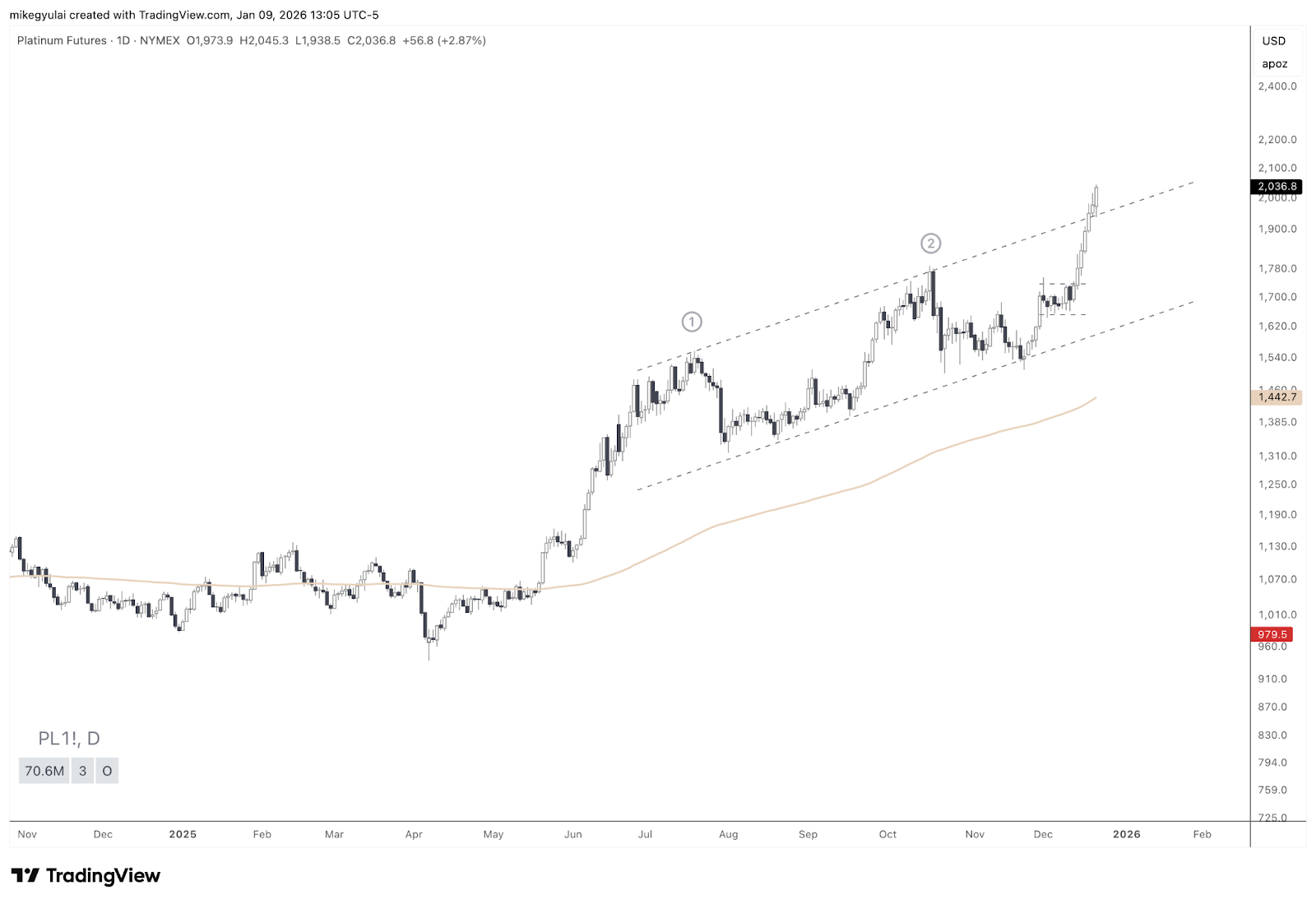
In the last issue of This Infinite Game before the holiday break, I showcased a beautiful rising channel in Platinum, and pointed out that price was attempting to break out.
Here was the chart at the time:
And here it was the following Friday:
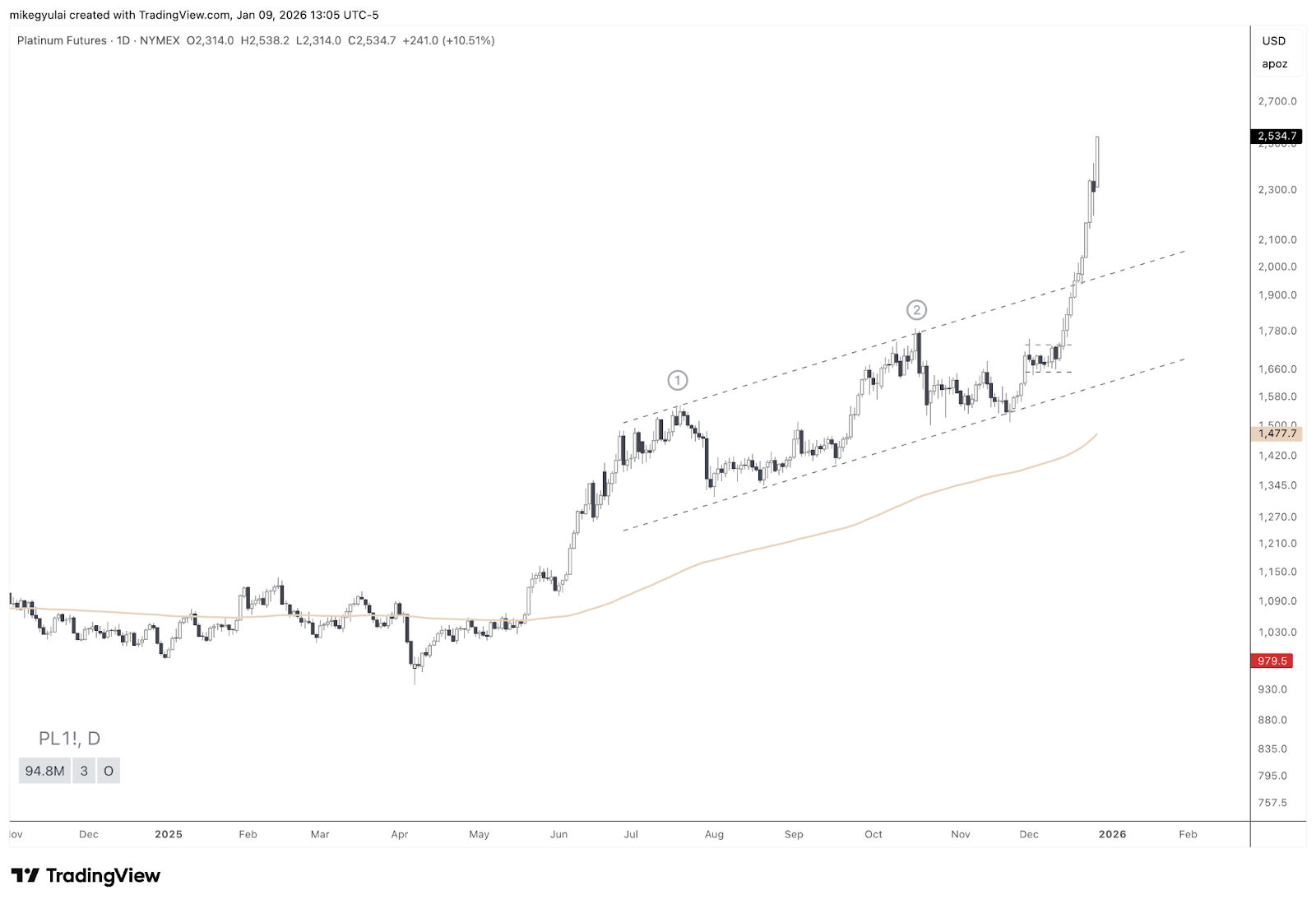
For short-term swing traders positioned to capture this move, I had advised the following:
Rising Channels can be thought of as slanted Rectangles. The difference is that price is already trending in the direction of the breakout—the slant of the channel—before the breakout takes place. This makes successful breakouts, by definition, trend accelerations that call for tight stop management in the form of fast-moving MAs or trailing prior bar lows.
Here is the difference in what three different trailing-stop techniques would have captured from this move: 1) trailing prior bar lows (green); 2) a Macro Ops favorite: the fast-moving 5-period DMA (orange); and, for comparison, the slow-moving 20-period DMA (blue):
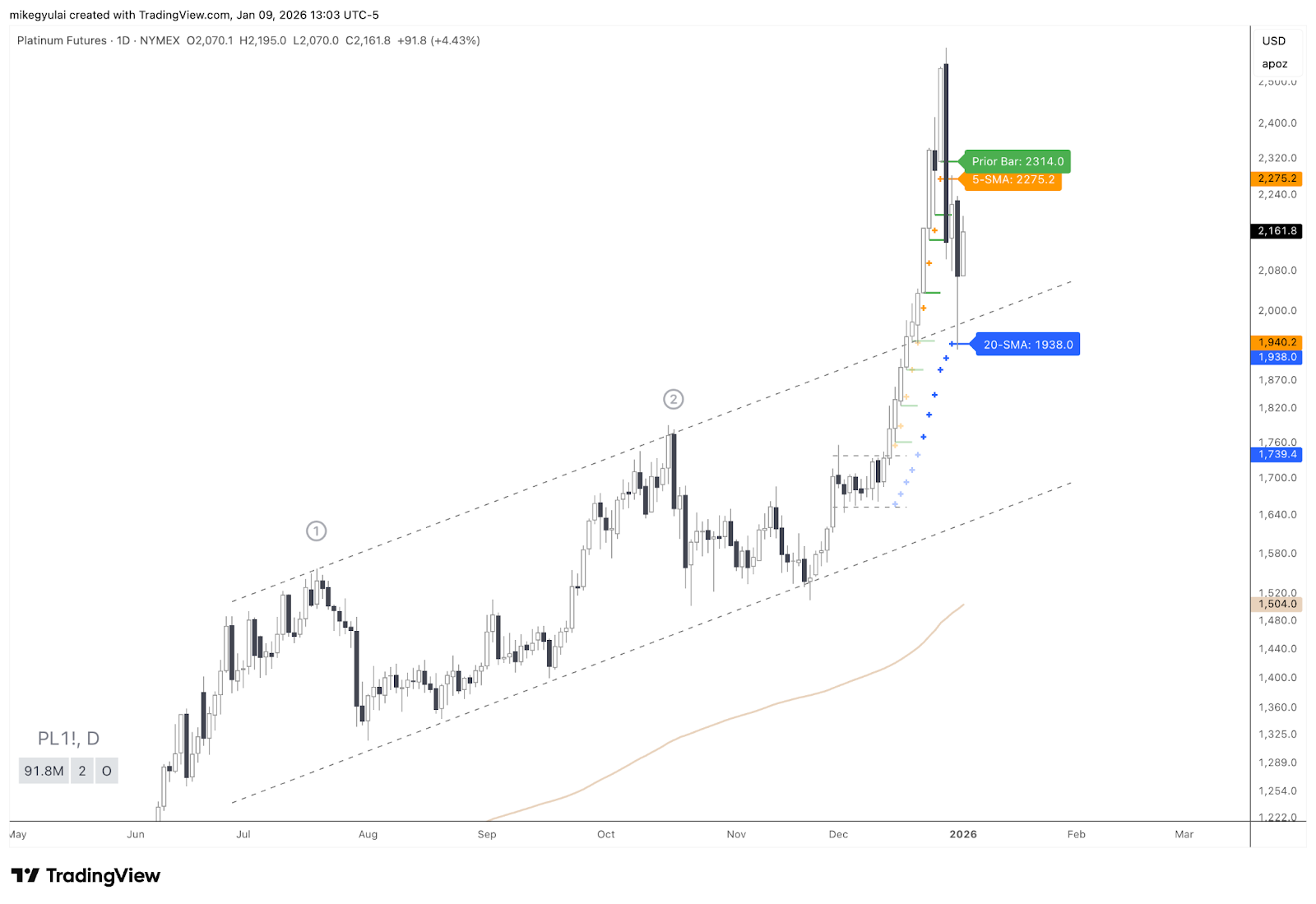
While Platinum wasn’t a position in our Macro Ops Portfolio, Copper has been. And our head macro trader, Alex, deployed the 5-period DMA this past week to capture partial profits on our position. A member of The Collective asked Alex how he chooses between the 5-period DMA vs. the 20-period. Here’s what he shared:
The 5DMA / 20DMA trail stop differentiation is really a function of two things 1) position size / overall portfolio correlation and 2) technical overextension levels. The more overextended a position is and the larger the position, the tighter the trail stop (5 vs 20 DMA) and vice versa.
Concepts from the Comm Center
Right before the end of the year, Collective member Mitul Patel shared a picture-perfect breakout trade in the Comm Center. While Euronext Paris is not part of my personal screening universe, Société Générale (GLE) fits all the criteria I look for in a breakout candidate:
A continuation pattern (Ascending Triangle here)
Multiple months in duration (3+ here)
Directionally supported by a long-term trend filter (the 200 EMA here)
With three or more reactions to a clearly defined price level (~59.40 here)
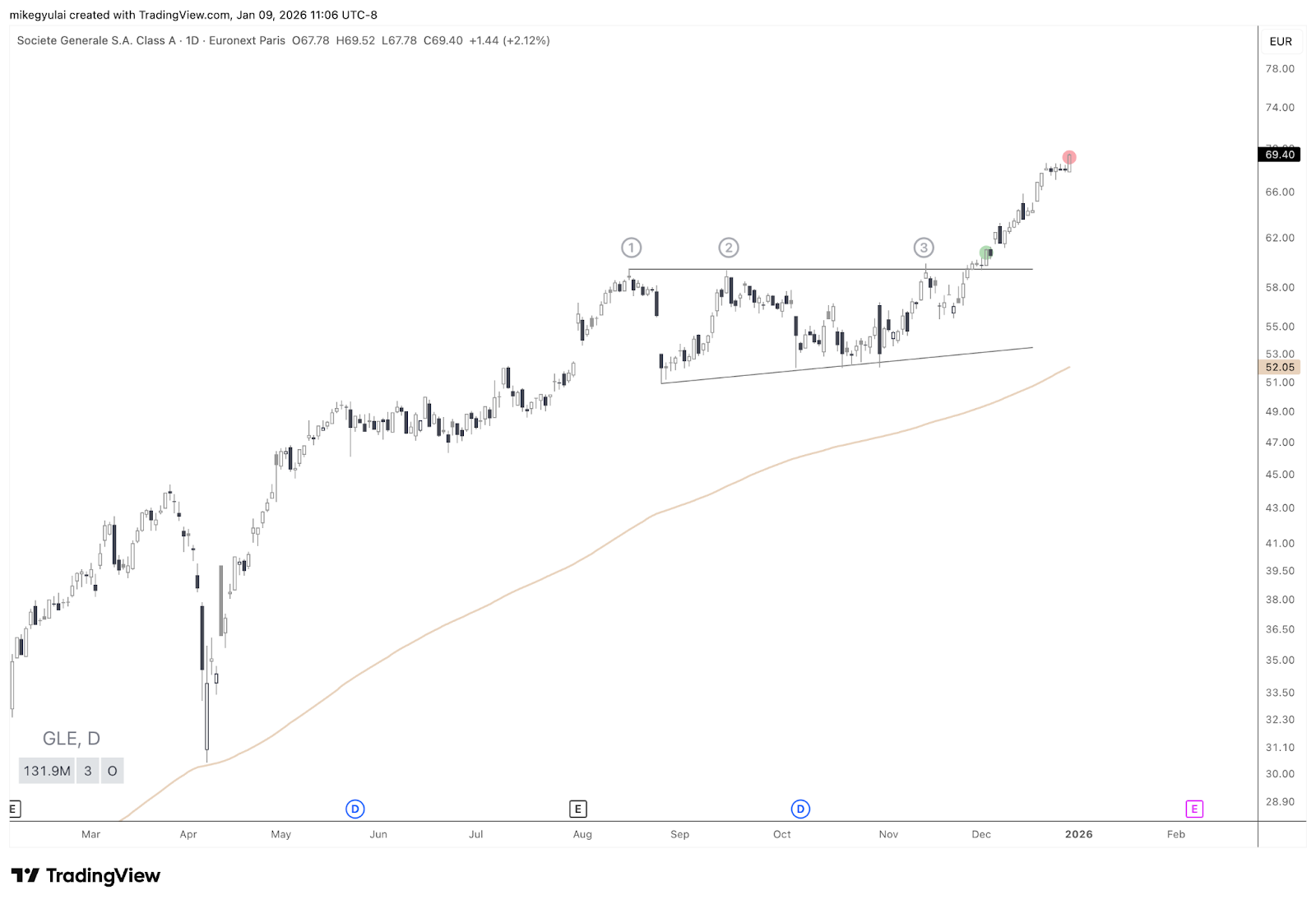
Breakout trades don’t get much cleaner than that. Great trade.
The pauses that refresh
Defensive names in Financial Services, Industrials and Consumer Staples have been carrying my portfolio since December. Yet my screens are brimming with pro-cyclical setups.
Here are the symbols I’m watching going into next week:
Active watchlists, real-time trade alerts, and live portfolio tracking are reserved for members of The Collective, our premier service offering discussions on high-level theory and performance, differentiated research, and a global community of serious traders and investors dedicated to mastery. Learn more about The Collective here.